
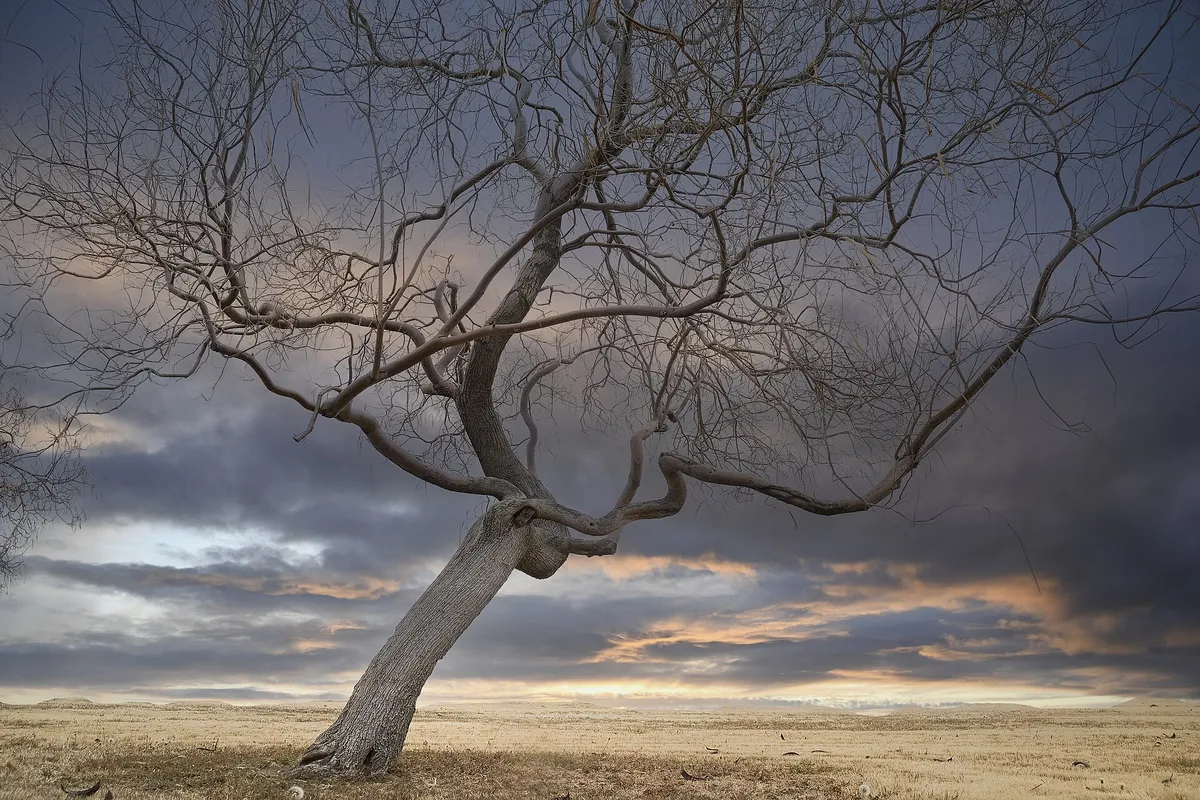
Photo: Almapayokels via Wikimedia Commons (CC0)

To kill mesquite instead of just knocking the top back, spray the herbicide where the plant can't regrow from. For bushy mesquite under about 6 feet tall with a full canopy, use a leaf spray of clopyralid plus triclopyr in water after the leaves turn a uniform dark green. For seedlings and small trees with three or fewer trunks, use a stem spray of triclopyr ester in diesel or basal oil on the bottom foot of every stem. Texas A&M AgriLife's Brush Busters program reports that these individual-plant methods kill 76% to 100% of treated mesquite when they're done right (Texas A&M AgriLife Brush Busters). Cutting, burning or blading alone usually just starts a thicker clump.
Why mesquite comes back
Mesquite resprouts from buds at and below the ground line. That's why a dozer pass or a chainsaw can turn one trunk into a multi-stemmed bush a few years later. Brush Busters says that after any top-kill, whether fire, cutting or mechanical work, you should wait two full growing seasons before leaf spraying, so the regrowth has enough leaf area to carry the herbicide down (Texas A&M AgriLife Brush Busters).
Leaf spray vs. stem spray
| Leaf spray | Stem spray | |
|---|---|---|
| Best for | Bushy mesquite under about 6 feet with good leaf cover | Seedlings and trees with no more than 3 basal stems, smooth bark |
| Herbicide | Clopyralid plus triclopyr in water, with surfactant and dye | Triclopyr ester in diesel or basal oil, or Invora with 1% methylated seed oil in water |
| When | After leaves go from light pea-green to uniform dark green; through July 31 in East and South Texas, through September elsewhere | Any time of year, best in the growing season; the Invora mix in late spring and summer |
| Where to spray | Wet all the leaves until they glisten, not drip | All sides of each stem from the ground line up to 12 inches |
The methods, timing and products in the table are from the Brush Busters mesquite publication (Texas A&M AgriLife Brush Busters).
Mesquite leaf spray mix
The Brush Busters leaf spray recipe is 0.5% Reclaim (clopyralid) plus 0.5% Remedy (triclopyr), with 0.25% surfactant and 0.25% to 0.5% dye so you can see what's been sprayed (Texas A&M Natural Resources Institute). In practice that works out to:
| Tank size | Each herbicide | Surfactant |
|---|---|---|
| 3 gallons | 2 oz | 1 oz |
| 14 gallons | 9 oz | 5 oz |
| 25 gallons | 16 oz | 8 oz |
Those amounts are from the same Texas A&M page (Texas A&M Natural Resources Institute). Product names change over time, so check the current label for the clopyralid and triclopyr products you buy, and follow it. The label is the law. To scale a mix to a bigger tank or a whole lease, use our spray acreage and herbicide mix calculator.
When to spray: timing and conditions
Timing is where most mesquite jobs succeed or fail. Brush Busters says to start leaf spraying once the leaves turn from light pea-green to a uniform dark green, and Texas A&M adds that soil temperature 12 to 18 inches deep should be at least 75°F (Texas A&M AgriLife Brush Busters; Texas A&M Natural Resources Institute). Angelo State University's brush control guidance puts the best soil temperature at 78°F to 83°F and advises against spraying when relative humidity is under 50%, air temperature is over 95°F, the plants are drought-stressed, or right after a rain of more than 3 inches (Angelo State University). It also suggests wind of 2 to 10 mph (Angelo State University).
Skip leaf spraying when (Texas A&M AgriLife Brush Busters):
- Rain has just pushed out flushes of new, light-green growth.
- The leaves are wet.
- Hail or insects have damaged the leaves.
- You'd be spraying upwind of plants you want to keep.
Stem spray for small mesquite
For stem spraying, Brush Busters lists triclopyr ester products (4 pounds acid equivalent per gallon) mixed with diesel or basal oil. Spray all sides of every stem from the ground line up to 12 inches high, enough to wet it without runoff or puddling. Don't spray wet stems. Rough, thick bark is harder to get through, which is why smooth-barked stems work best (Texas A&M AgriLife Brush Busters). The county Brush Busters mixing guide uses a 15% triclopyr mix for smooth bark and 25% for rough bark. For smooth bark that's 19 oz in 1 gallon, 3 quarts in 5 gallons or 1.5 gallons in 10 gallons of mix (Brush Busters mixing guide). A narrow-angle Conejet 5500-X1 or X2 tip cuts the amount of spray used by 80%, according to Brush Busters (Texas A&M AgriLife Brush Busters).
Equipment and coverage
For leaf spray, Brush Busters recommends an adjustable cone nozzle such as a Conejet 5500-X6 or X8 set for a coarse spray, so droplets land on the bush instead of drifting (Texas A&M AgriLife Brush Busters). Walk around each plant and wet the whole canopy, including the top and far side. Leaving part of the plant dry is the most common reason a "dead" mesquite leafs out again next spring.
Follow up every year
Brush Busters says to check treated areas every year and spot-treat survivors and new seedlings while they're small (Texas A&M AgriLife Brush Busters). Wait at least through the next growing season before judging results, since mesquite can take that long to show whether the roots died. On pads, roads and pipeline corridors, pair mesquite work with the rest of your vegetation plan. See our guides to lease and pad weed control, pipeline right-of-way vegetation control and, for creek and pit edges, salt cedar control.
For other West Texas brush on the same leases, see how to kill prickly pear and how to kill silverleaf nightshade.
Creosote bush (greasewood) on the same ground needs a different tool: AgriLife lists tebuthiuron pellets, not a leaf spray. See how to kill creosote bush.
Mesquite taking over a lease road, pad edge or right-of-way? Our Texas Department of Agriculture licensed applicators handle brush and weed control across the Permian Basin.
Get a weed control quoteFAQ
What is the best way to kill mesquite trees?
For bushy mesquite under about 6 feet, use a leaf spray of clopyralid plus triclopyr after the leaves turn uniform dark green. For small trees with three or fewer trunks, stem spray triclopyr ester in diesel or basal oil on the bottom 12 inches. Texas A&M AgriLife reports 76% to 100% kill with these methods.
What is the Brush Busters mix for mesquite leaf spray?
0.5% clopyralid (Reclaim) plus 0.5% triclopyr (Remedy), with 0.25% surfactant and 0.25% to 0.5% dye. For a 3-gallon sprayer that's 2 oz of each herbicide and 1 oz of surfactant.
When is the best time to spray mesquite?
After the leaves change from light pea-green to uniform dark green and soil 12 to 18 inches deep is at least 75°F. Texas A&M says through July 31 in East and South Texas and through September elsewhere.
Does cutting down a mesquite kill it?
Usually not. Mesquite resprouts from buds near the ground line. Brush Busters says to wait two full growing seasons after cutting, burning or mechanical work before leaf spraying the regrowth.
Can you spray mesquite after it rains?
Not right away if rain has pushed out new light-green growth or the leaves are wet. Angelo State also advises against spraying right after a rain of more than 3 inches.
How long does it take to know if mesquite is dead?
Give it through the next growing season. Brush Busters recommends checking treated areas every year and spot-treating survivors.