
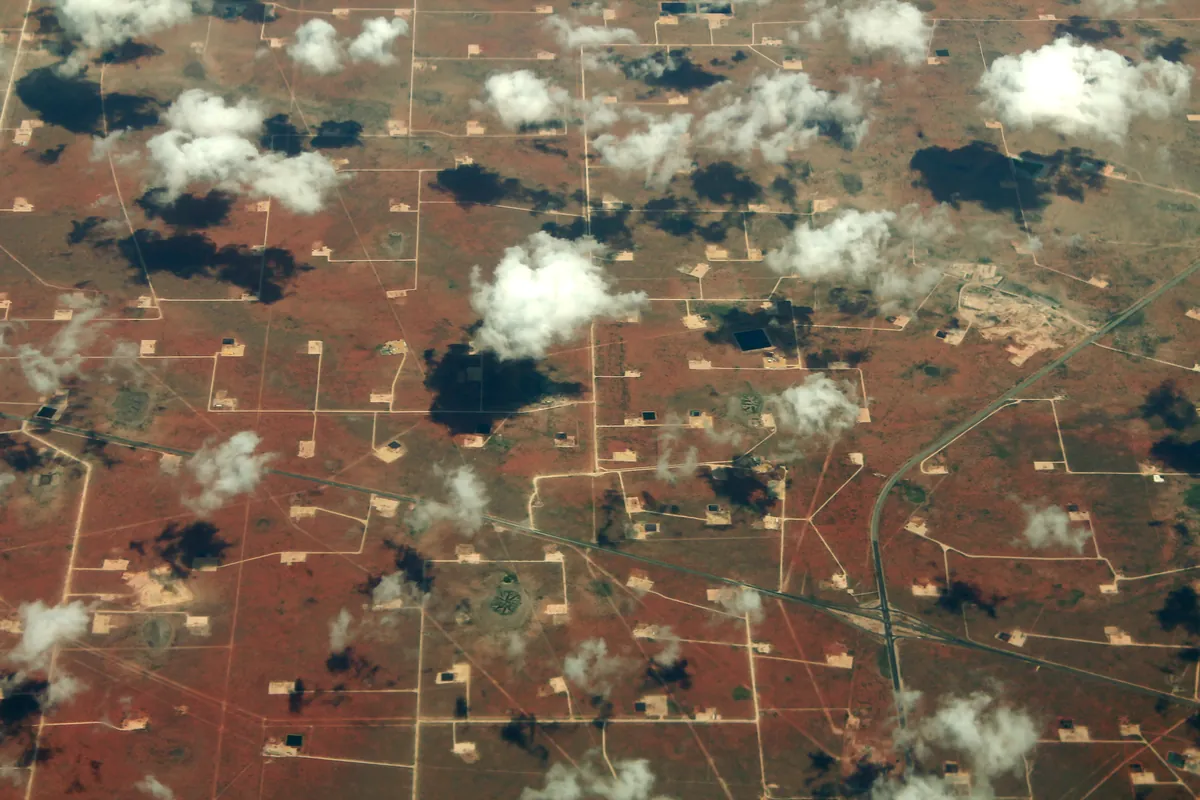
Photo: formulanone, CC BY-SA 2.0, via Wikimedia Commons

Pipeline operators keep the right-of-way (ROW) clear so the line can be patrolled and its markers can be seen. Federal pipeline safety rules require gas transmission operators to patrol the ROW on a set schedule, and hazardous liquid operators to inspect it at least 26 times a year. Brush that hides the ground or the markers defeats both.
In Texas, spraying herbicide on a ROW for hire takes a Texas Department of Agriculture (TDA) commercial applicator license, and the category written for this work is Category 5, Vegetation management. In Midland, Martin and several other West Texas counties, a TDA spray permit is also required before using 2,4-D, dicamba, MCPA or quinclorac. This is a plain-language summary, not legal advice. Check the current rules and the product label before every job.
Why the right-of-way has to stay open
Gas transmission operators must run a patrol program to watch surface conditions on and next to the ROW for signs of leaks, construction activity and anything else that affects safety. Patrols can be done by walking, driving or flying. The maximum interval depends on the class location, which is set by how many buildings are near the line (49 CFR 192.705):
| Class location | At highway and railroad crossings | Everywhere else |
|---|---|---|
| Class 1 and 2 | 7½ months, at least twice each calendar year | 15 months, at least once each calendar year |
| Class 3 | 4½ months, at least four times each calendar year | 7½ months, at least twice each calendar year |
| Class 4 | 4½ months, at least four times each calendar year | 4½ months, at least four times each calendar year |
Crude oil, products and other hazardous liquid lines are held to a tighter schedule. Operators must inspect surface conditions on or next to each ROW at intervals of no more than 3 weeks, and at least 26 times each calendar year (49 CFR 195.412). A patrol pilot or line rider cannot report what the brush is hiding.
Line markers are the other reason. Both rule sets require markers at road and railroad crossings and wherever else they are needed to show where the line is. Each marker carries the word Warning, Caution or Danger, the product, and the operator's name and a phone number that is answered at all times (49 CFR 192.707, 195.410). A marker grown over with brush keeps that warning, and that phone number, out of sight of the next person with a backhoe.
For intrastate lines, the Railroad Commission's pipeline safety rules adopt Parts 192 and 195 by reference, so the same patrol and marker rules apply to lines that never leave Texas (16 TAC §8.1).
The license: TDA Category 5, Vegetation management
TDA certifies commercial applicators by category, and each category covers specific work. Category 5, Vegetation management, covers applicators who control unwanted plant growth on rights-of-way and in the maintenance of roads, utility lines, pipelines, railways, airports, ditches, and industrial sites including oil field sites (4 TAC §7.21). When you hire a sprayer for ROW work, ask which categories are on the license, not just whether they have one.
Ask for the records, too. Commercial applicators must keep a record of every application for two years. Each record includes the date and start time, who the work was for, the location, the product name and EPA registration number, the rate and total volume applied, the target pest, the site and acres treated, wind direction and speed, air temperature, the method, and the applicator's name and license number. In a regulated county it also includes the spray permit number when a regulated herbicide was used (4 TAC §7.33). A copy of that record is what proves the work was done if a landowner or auditor asks.
Regulated herbicides in Midland and nearby counties
TDA treats 2,4-D, MCPA, dicamba and quinclorac as regulated herbicides in a list of designated counties (TDA). In and near the Permian, that list includes Midland, Martin, Dawson, Gaines, Ward, Loving and Culberson counties (4 TAC §7.52). Ector, Andrews, Howard, Glasscock and Reeves were not on it when this guide was written. Some counties also have special provisions (4 TAC §7.53). In Gaines County, no permit is needed from October 1 through March 31. In Dawson County, none is needed from October 1 through April 15, and ester and other high-volatile formulations of 2,4-D are banned. Check the rules for every county the line crosses.
In a regulated county, a TDA spray permit is needed before applying these products. A permit expires when the permitted acreage has been sprayed or 180 days after it was issued, whichever comes first. Brush, mop, wick, basal and injection applications do not need a permit (4 TAC §7.50). Some rules apply whether or not a permit is needed:
- No spraying when the wind is over 10 mph, or over the label's limit if that is lower.
- No turbine or blower-type ground sprayers.
- No high-volatile herbicides, such as the volatile ester formulations, when susceptible crops are within a four-mile radius of the land being sprayed.
Triclopyr, clopyralid and aminopyralid, the active ingredients in the mesquite mixes below, are not on the regulated list.
Mesquite and brush on the ROW
Mesquite is the brush that takes over most West Texas rights-of-way. Texas A&M AgriLife's Brush Busters program recommends two individual-plant methods and says you should kill about 7 of 10 trees with either one (AgriLife, How to Beat Mesquite).
Leaf spray is for bushy mesquite under 6 to 8 feet tall with many stems at ground level. AgriLife gives two mixes, both in water with a nonionic surfactant: a premix of aminopyralid and clopyralid at 1 percent of the spray solution, or triclopyr ester and clopyralid at half a percent each. Timing matters more than the mix:
- Start in spring after the soil reaches 75°F at 12 inches deep and the leaves have turned from light pea green to a uniform dark green.
- Outside east and south Texas, you can keep spraying through September.
- Skip days when recent rain has pushed out new light green growth, when the leaves are wet or damaged, or when the trees are upwind of plants you want to keep.
- If the mesquite was top-killed by fire, cutting, herbicide or shredding, wait two full growing seasons before leaf spraying.
That last point catches a lot of ROW programs. A corridor that was shredded last year is not ready for a leaf spray this year.
Stem spray, or low-volume basal, is for smooth-bark mesquite with a few well-defined stems. The mix is triclopyr ester in diesel: 15 percent for smooth stems 1.5 inches across or less, and 25 percent for stems 1.5 to 4 inches or rough bark. Spray every side of the trunk from the ground line to 12 inches up. It works any time of year, best in the growing season, but not on wet stems, and thick grass around the base makes it less effective. Basal application is also one of the methods exempt from a TDA spray permit. With any product, the label sets the legal rate and restrictions.
Controlling mesquite is not a one-time job. AgriLife notes that livestock and wildlife keep spreading the seed, so plan to come back for seedlings.
Planning a ROW spray job
A ROW job goes faster and drifts less when the sprayer has this up front:
- A map or KMZ of the line, with the stretches, crossings and above-ground sites (valves, risers, markers) to be treated
- The counties it crosses, so regulated-herbicide rules and permits are sorted out first
- Landowner restrictions, grazing, and nearby crops, gardens, stock tanks or draws that need a buffer
- Gate combinations, access routes, and the operator's site safety rules
- Who receives the application records after each visit
How we help
Simba Services is a TDA-licensed commercial applicator, and we do weed control on leases, pads, lease roads and pipeline rights-of-way around Midland, Odessa and the Permian Basin. Our guide to lease and pad weed control covers bare-ground treatments around equipment. If you are vetting any contractor, see what to ask before hiring an oilfield service company.
Need a right-of-way sprayed? Send the line map or the counties and we will quote it.
Get a ROW spraying quoteFAQ
Why do pipeline companies keep the right-of-way clear?
So patrols can see the ground for leaks and digging, and so line markers stay visible. Federal rules set patrol intervals for gas transmission lines and require hazardous liquid ROW inspections at least 26 times a year.
How often must a pipeline right-of-way be patrolled?
For gas transmission lines it depends on class location. In Class 1 and 2 areas, crossings are patrolled at least twice a year and other stretches at least once a year. Hazardous liquid lines are inspected at intervals of no more than 3 weeks, at least 26 times a year.
What TDA license category covers pipeline right-of-way spraying?
Category 5, Vegetation management. It covers rights-of-way, roads, utility lines, pipelines, railways and industrial sites, including oil field sites.
Do you need a permit to spray 2,4-D in Midland County?
Yes. Midland County is a regulated county, so 2,4-D, dicamba, MCPA and quinclorac need a TDA spray permit. Brush, mop, wick, basal and injection applications are exempt from the permit.
Is Ector County a regulated herbicide county?
Ector County, home of Odessa, was not on TDA's regulated-herbicide county list when this guide was written. Neighboring Midland, Martin and Ward counties are. Check TDA's current list before spraying 2,4-D, dicamba, MCPA or quinclorac.
When is the best time to spray mesquite on a right-of-way?
For a leaf spray, start after the soil reaches 75°F at 12 inches deep and the leaves are uniformly dark green. Outside east and south Texas you can spray through September. Stem sprays can go on any time of year.