
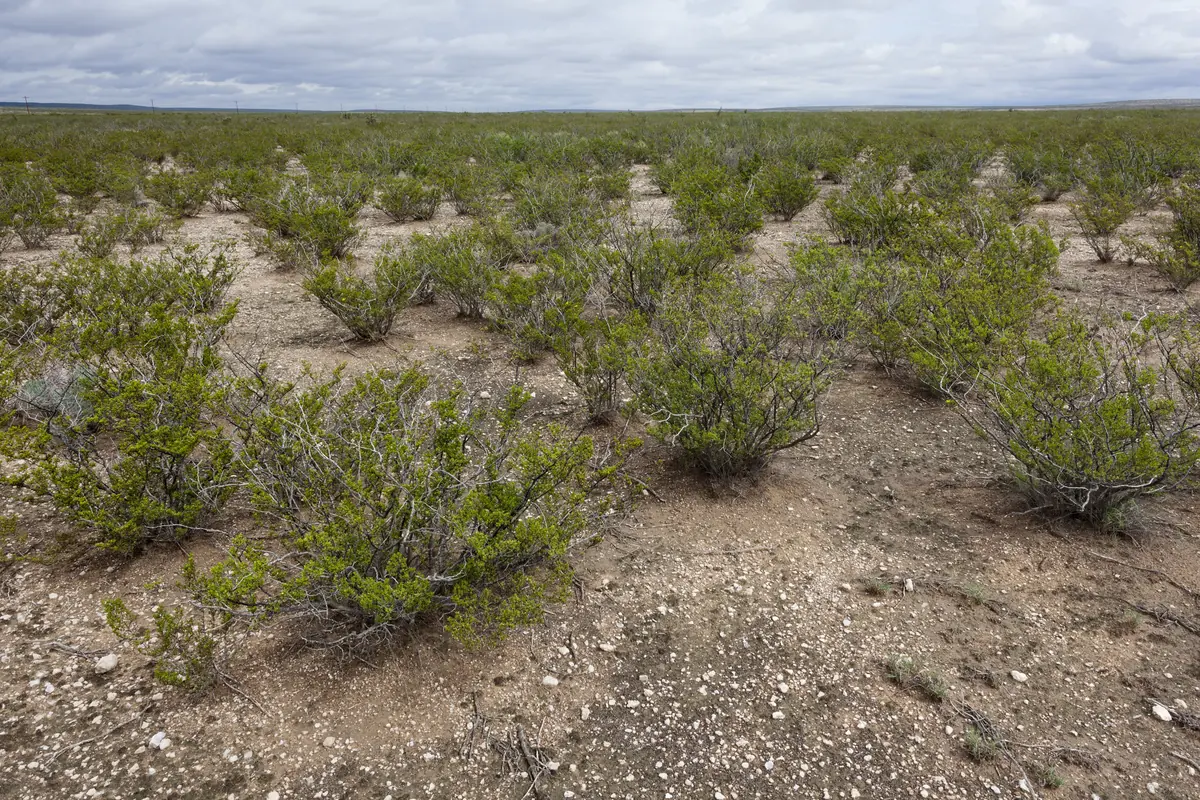
Photo: Patrick Alexander via Wikimedia Commons, CC0 1.0, cropped

To kill creosote bush (greasewood) in Texas, Texas A&M AgriLife suggests tebuthiuron 20% pellets spread on the soil. Broadcast 3.75 to 5 pounds of pellets per acre (0.75 to 1 pound of active ingredient), or treat single plants with 0.5 ounce of pellets per 100 square feet of ground under the plant. You can apply any time of year, but May 1 to July 1 works best. Use the low rate on sandy soils. Skip slopes of 7% or more and gyp soils (AgriLife ERM-1466). AgriLife doesn't list a leaf spray for it, and in field trials disking and railing left far more plants alive than pellets did.
Why creosote bush is hard to kill
Creosotebush, also called greasewood, is an evergreen shrub that grows thick and widespread across the deserts of the southwestern United States and northern Mexico. It takes moisture and nutrients that forage grasses need. AgriLife lists chemical, mechanical and prescribed-burn options for it (Texas A&M AgriLife). On the western side of the Permian Basin, toward the Trans-Pecos, that often means the same dry, gravelly ground where lease roads and pads get built.
Creosote also doesn't respond to the leaf sprays crews use on mesquite. In AgriLife's 2026 brush table, creosotebush shares a line with tarbush and whitethorn acacia. The only suggested treatment on that line is tebuthiuron pellets, applied to the ground instead of the leaves (AgriLife ERM-1466).
Tebuthiuron rates from AgriLife ERM-1466
ERM-1466 gives each treatment a control rating. Very High means 76% to 100% of treated plants die. High means 56% to 75% (AgriLife ERM-1466). For creosotebush, tarbush and whitethorn acacia:
| Treatment | Rate | Rating |
|---|---|---|
| Broadcast tebuthiuron 20% pellets | 3.75–5 lb pellets/acre (0.75–1 lb active) | High |
| Individual plant, tebuthiuron 20% pellets | 0.5 oz pellets (0.1 oz active) per 100 sq ft of ground | Very High |
Timing is "anytime," with May 1 to July 1 the best window. Use the 5-pound rate on loam, silt loam, silt, sandy clay loam or clay loam. Drop to the low rate on sand, loamy sand or sandy loam. Do not treat mountainsides or gravelly ridges with slopes of 7% or more. Do not treat soils with a cation exchange capacity above 30 meq/100 grams, which AgriLife notes are commonly called "gyp" soils (AgriLife ERM-1466). Spike 20P is the 20% pellet product named in the herbicide table (AgriLife ERM-1466).
For single plants, measure the ground under the canopy and treat it at the pellet rate. A patch of canopy about 10 by 10 feet covers 100 square feet, so it gets about half an ounce of pellets, spread evenly over that ground.
What the field trials found
Two studies show what to expect after treatment. In south Brewster County, Texas, researchers broadcast tebuthiuron at 1.5 pounds of active ingredient per acre in April 1984. Three years later, 94% of the creosotebush was dead on a gravelly site, but only 55% on a draw site. On the gravelly site, grass production rose to 960 pounds per acre, compared with 161 on untreated ground. Mesquite on the same plots was barely touched (10% and 0% mortality), so tebuthiuron at that rate is a creosote and catclaw tool, not a mesquite tool (Texas Journal of Agriculture and Natural Resources).
A Journal of Range Management study tested tebuthiuron against mechanical work at four Chihuahuan and Sonoran Desert sites. Averaged across sites and years, creosotebush mortality was 75%, 87% and 93% for tebuthiuron at 0.5, 1.0 and 1.5 kg active per hectare (roughly 0.45, 0.9 and 1.3 lb per acre). The mechanical treatments did worse. Land imprinting killed 3%, two-way railing 33%, and disk plowing 68% whether or not contour furrows were added. At the Arizona site, disk plowing also destroyed the perennial grasses you're trying to bring back (Morton et al., Journal of Range Management).
The lesson for a lease or pasture: pellets on the right soil beat iron. Grass recovers best where some native grass is still left to release (Morton et al.).
Where creosote control fits on oilfield ground
On a working pad, tank battery or compressor site where you want nothing growing, creosote is just one more target in a bare-ground herbicide program. On lease roads, pasture and pipeline right-of-way where the landowner wants grass, treat it with selective products. Match the treatment to each species. Mesquite needs its own leaf or stem spray, and cactus needs a pad spray. Check the soil type and slope before you spread pellets, because ERM-1466's limits on sandy soils, steep gravelly ridges and gyp soils apply to every acre.
Before you buy product, AgriLife reminds users that its suggestions are based on Texas research and that every herbicide must be registered with EPA and approved for use in Texas by the Texas Department of Agriculture. The user is responsible for residue effects on livestock and crops and for any drift or movement off the property, so read and follow the current label (AgriLife ERM-1466). For tank or spreader math across many acres, our spray acreage and herbicide mix calculator converts field size into product needed at your label rate. For the rest of the weed list on a lease, see lease and pad weed control.
Creosote bush taking over a lease road, pad edge or pasture? Our Texas Department of Agriculture licensed applicators handle brush and weed control across the Permian Basin.
Get a weed control quoteFAQ
What is the best herbicide for creosote bush?
Texas A&M AgriLife's ERM-1466 suggests tebuthiuron 20% pellets (such as Spike 20P) for creosotebush, tarbush and whitethorn acacia. Broadcast use is rated High (56% to 75% of plants killed) and individual-plant use is rated Very High (76% to 100%).
How much tebuthiuron per acre for creosote bush?
ERM-1466 lists 3.75 to 5 pounds of 20% pellets per acre (0.75 to 1 pound active ingredient). Use 5 pounds on loam, silt loam, silt, sandy clay loam or clay loam, and the low rate on sand, loamy sand or sandy loam.
How do you treat a single creosote bush?
Spread 0.5 ounce of tebuthiuron 20% pellets (0.1 ounce active) per 100 square feet of ground area under the plant, spread evenly, following the product label.
When should you treat creosote bush?
AgriLife lists the timing as anytime, with the best window May 1 to July 1.
Does disking or chaining kill creosote bush?
Less reliably than pellets. In a Journal of Range Management study, disk plowing killed about 68% of creosotebush, two-way railing 33% and land imprinting 3%, while tebuthiuron killed 75% to 93% depending on rate. Disk plowing also destroyed perennial grasses at one site.
Where should you not use tebuthiuron on creosote?
ERM-1466 says not to treat mountainsides or gravelly ridges with slopes of 7% or more, or soils with a cation exchange capacity above 30 meq/100 g (gyp soils). Always follow the current label.