
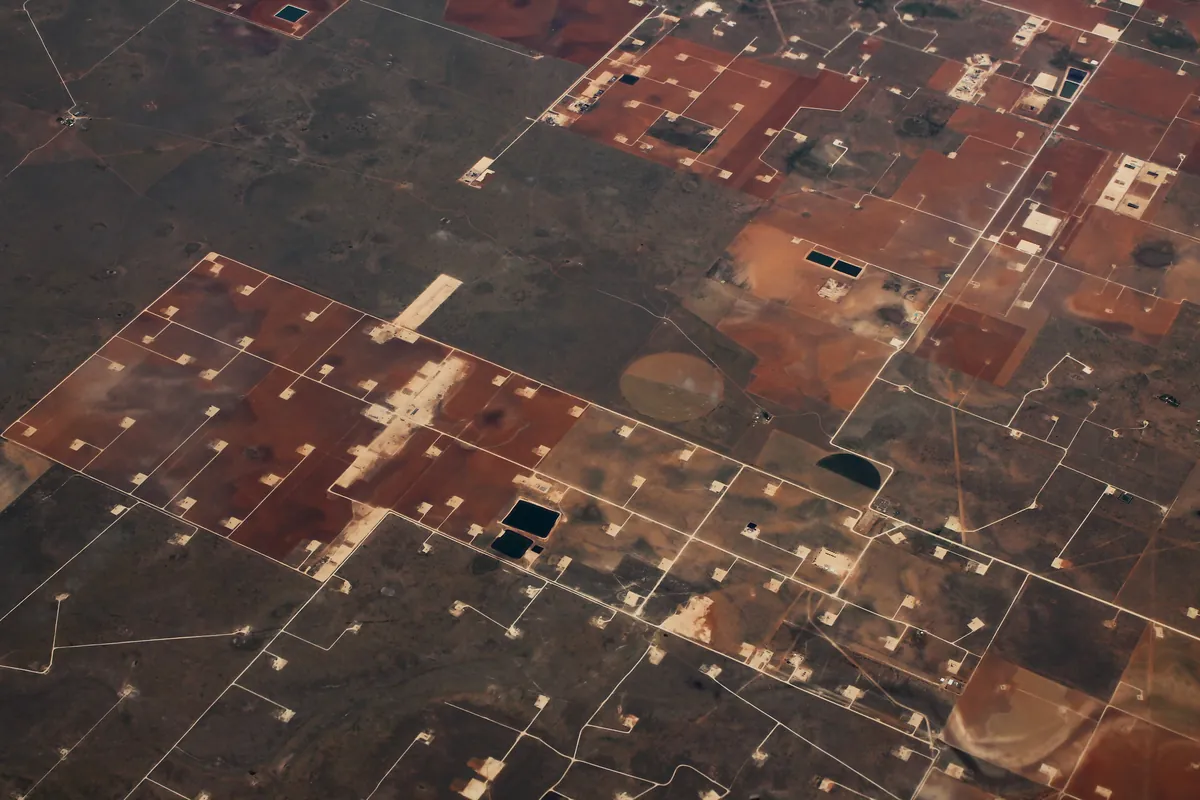
Photo: formulanone, CC BY-SA 2.0, via Wikimedia Commons

Bare-ground weed control on a well pad uses a soil-active (residual) herbicide that sits in the top layer of soil and kills weed seedlings as they sprout. It is almost always paired with a burndown product for anything already green. It is not permanent: the residual controls plants for a period and then breaks down, so a pad needs a program, not a one-time spray. How long a given pad stays clean depends on the product and rate on the label, whether rain moves it into the soil, the soil itself, and when it went down.
This guide covers how residuals work and why they fail. For the wider program on a lease (what grows, spot spraying, scheduling), start with our oilfield lease weed control guide.
What "bare ground" means on a lease
Weed scientists call it total vegetation control (TVC): keeping a site free of all plants for safety, fire, access or inspection. A Colorado State study in Weed Technology names oil and gas facilities among the places it is used, alongside railroads, power substations, airports and roadsides (Sebastian et al., 2019). On a Permian lease that usually means the pad, the tank battery, compressor and separator sites, and a strip around equipment and fences.
A bare-ground treatment has two jobs, and one product rarely does both:
- Residual (pre-emergent): stays in the soil and stops new seedlings. A University of Kentucky industrial vegetation management report lists prodiamine, pendimethalin, bromacil and diuron as examples (UK Extension, Total Vegetation Control).
- Burndown (post-emergent): kills what is already up. The same report says pre-emergents need a partner such as glyphosate or imazapyr when weeds are actively growing, and notes that many products have both pre- and post-emergent activity.
"Soil sterilant" is a common name for this work, but it is misleading. The Pacific Northwest Weed Management Handbook notes that soil-residual herbicides do not kill all animal and microbial life in the soil (PNW Handbook, non-cropland vegetation control). They control plants for a period, then break down.
Why rain decides whether it works
A residual herbicide lying on dry caliche does very little. It has to be moved into the top inch or two of soil, where seeds germinate. Purdue University's Pest&Crop newsletter puts the general need at about half an inch of rain to activate many residual herbicides, and says most labels want that activating rain within 7 to 10 days of application. Encapsulated formulations often need more. Purdue adds that shallow cultivation rarely activates a residual in place of rain (Purdue Pest&Crop).
The 7 to 10 day window is not mainly about the product breaking down, Purdue explains. It is that if no activating rain comes in that time, weeds have already emerged, and a residual will not control weeds that are already up. Dry spells are normal in West Texas, so this is a common reason a "sprayed" pad greens up anyway, and why a burndown pass often has to follow.
Fall vs. spring application
The Colorado State team compared 32 treatment combinations with two industry standards at five Colorado sites in 2013 and 2014. In three of the five sites, fall applications outperformed the same treatments applied in spring (Sebastian et al. 2019). The PNW Handbook gives the reason for its own dry interior region: apply soil-residual herbicides in late fall so winter precipitation moves them into the soil.
Colorado and eastern Oregon are not the Permian, but the logic carries: a residual applied ahead of the wetter part of the year has a better chance of being activated before weeds sprout. Spring treatments still work when rain follows. A spring or summer visit is also when you catch anything that came through.
What held up in the research
The study ranked treatments by how well they kept ground bare across sites and both timings. Seven top-ranked treatments averaged 96% bare ground. A few findings are useful when you compare contractor proposals:
| Finding | What it means for a pad |
|---|---|
| The industry standard diuron + imazapyr was in the top ranking | A long-used mix still holds up |
| Four of the seven top treatments included aminocyclopyrachlor, chlorsulfuron and indaziflam; adding imazapyr gave the highest predicted chance of 100% bare ground | Newer, lower use rate combinations can match or beat the old standards |
| Bromacil + diuron performed inconsistently | An older standard is not automatically the safe bet |
| Earlier research the authors cite found tank-mixing two effective modes of action better for resistance management than rotating them | Ask whether a proposal uses more than one mode of action |
Resistance management was one of the study's main goals, because spraying the same site the same way year after year selects for weeds that survive it. Kochia, the weed behind many Permian tumbleweeds, is a known problem; see how to get rid of tumbleweeds on oilfield sites.
These are research rankings, not a prescription. The label sets the rate, the sites it may be used on, and the limits. That is the law, and it differs from product to product.
Where bare ground goes wrong
A residual that stays put is the goal. One that moves causes the problems:
- Roots past the pad edge. The PNW Handbook says not to apply where roots of desirable vegetation may extend into the treated area. Trees and pasture next to a pad can take up product from treated soil.
- Treated soil that moves. The same handbook says to keep people, animals and equipment from moving soil away from the treated area, and to avoid applying where wind or water might move it. Blading a pad, pushing caliche into a ditch, or a washout after a storm carries the herbicide with it.
- Water. The PNW Handbook warns that some crops are extremely sensitive to these herbicides and that irrigation water contamination has caused severe crop losses. Keep them out of stock tanks, draws and any water that reaches a field.
- Volatile products in heat. The PNW Handbook notes some herbicides vaporize easily and recommends applying at lower temperatures with low-volatile formulations. On a Permian summer afternoon that matters.
The same caution applies years later, when a well is plugged and the landowner wants the pad back. Spreading pad material onto pasture or seeding it without checking what was applied can set restoration back. Our guide to well site restoration after plugging covers that end of a pad's life, and caliche pads and lease roads covers building and maintaining them.
Before you schedule bare ground
- Mark the pad edges and anything you want left alive: trees, pasture, a landowner's garden near the lease road.
- Flag stock tanks, draws and low spots that collect runoff.
- Check the surface use agreement for limits on products or areas.
- Time the residual ahead of expected moisture, and plan a burndown if anything is green.
- Ask for the application record after each visit. Texas licensed applicators must keep records of every application (4 TAC §7.33), including the product, its EPA registration number, the rate and the site.
Need pads, tank batteries or compressor sites kept bare? We are a TDA-licensed commercial applicator working Midland, Odessa and the Permian Basin.
Get a weed control quoteFAQ
How long does bare ground herbicide last on a well pad?
There is no single number. It depends on the product and rate on the label, whether rain activates it, the soil, and the timing. Residuals control plants for a period and then break down, so most pads need a yearly program with follow-up spraying.
Is a soil sterilant permanent?
No. Soil-residual herbicides control plants for a period and then break down. The Pacific Northwest Weed Management Handbook also notes they do not kill all animal and microbial life in the soil, so the name soil sterilant overstates what they do.
Does bare ground herbicide need rain?
Yes. Purdue University says many residual herbicides need about half an inch of rain to move into the soil, and most labels want it within 7 to 10 days of application. Without it, weeds emerge before the product is activated and the residual will not control them.
Is fall or spring better for bare ground treatment?
In a Colorado State study at five semi-arid sites, fall applications beat spring at three of them, and extension guidance favors late fall so winter moisture moves the herbicide into the soil. Spring treatments work too when rain follows.
Can bare ground herbicide hurt trees next to the pad?
It can. Soil-residual herbicides should not go where roots of desirable plants may extend, and treated soil should not be moved by blading, runoff or wind. Mark trees and pasture edges before the crew sprays.
Do I need a burndown with a pre-emergent?
Usually. Pre-emergents stop new seedlings but do little to weeds that are already up. Extension guidance pairs them with a post-emergent such as glyphosate or imazapyr when green weeds are present.