
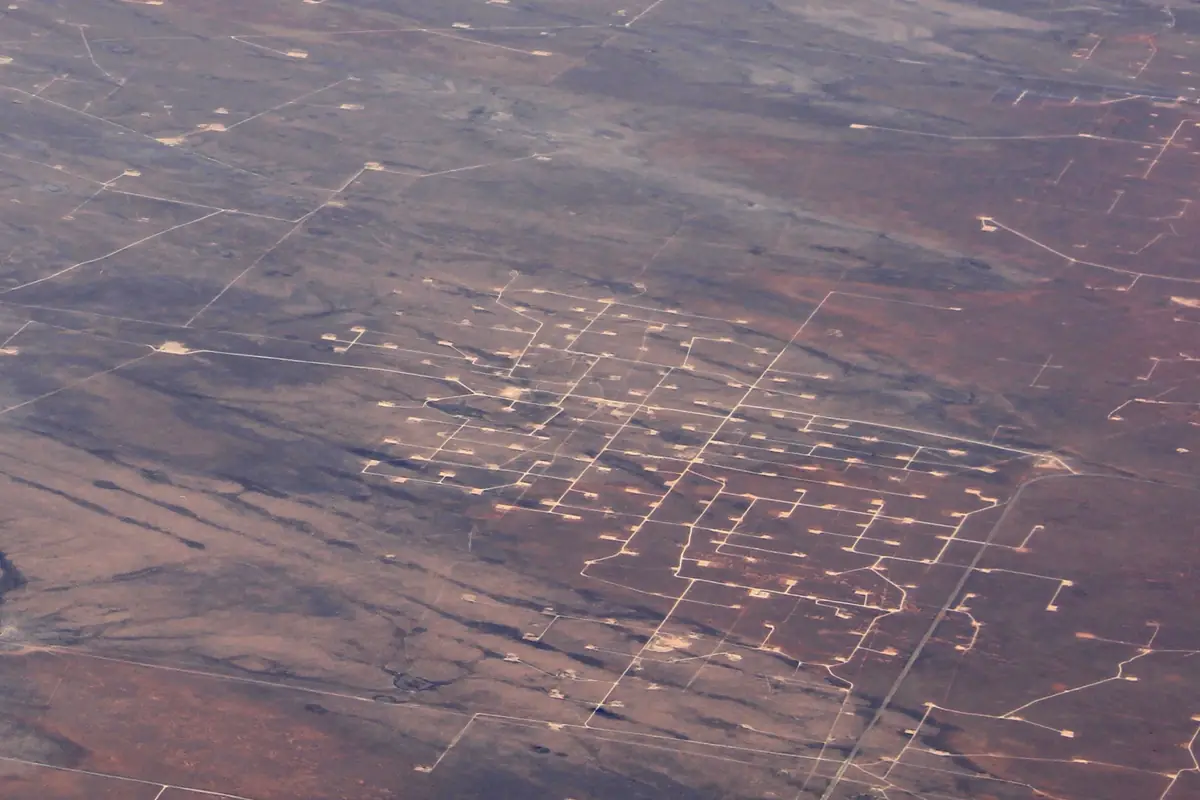
Photo: antoine fleitz, CC BY-SA 4.0, via Wikimedia Commons (cropped, contrast adjusted)

A good caliche pad or lease road comes down to three things: sound material, compaction at the right moisture, and a shape that sheds water. Caliche is spread in layers, watered and rolled until it sets up hard, and the finished surface is crowned or sloped so rain runs off instead of sitting on it. The Federal Highway Administration's guide for unpaved roads recommends a crown of about 1/2 inch per foot, roughly 4 percent, and says not to go over 6 percent (FHWA Gravel Roads Construction & Maintenance Guide). Most of the potholes, soft spots and washboard you fight later trace back to water and shape, not to the caliche itself.
What caliche is
Caliche is the hard, light-colored layer of soil cemented by calcium carbonate that lies under much of West Texas. The Handbook of Texas describes it as the indurated layer "so common in West and South Texas" (TSHA). It is dug from local pits, which is why it became the default surface for well pads and lease roads across the Permian Basin. Look at the photo above: the pale lines and squares across the ranchland are caliche roads and pads.
Caliche is not uniform. Material from one pit can bind and hold a surface well while another is soft, chalky or full of oversize rock. The FHWA guide makes the same point about any surface gravel: it needs the right blend of stone, sand and fines that bind. If you are buying caliche, look at roads already built from that pit before you commit to it.
Where the caliche comes from
Texas counts caliche as an aggregate. Under TCEQ's aggregate production operation (APO) rules, each location where aggregate is extracted must be registered, at least 10 business days before extraction starts, and renewed every year (TCEQ). Fees depend on the acres disturbed:
| Acres disturbed | TCEQ APO fee |
|---|---|
| 0 to 10 | $474 |
| More than 10, up to 50 | $790 |
| More than 50, up to 100 | $1,106 |
| More than 100 | $1,500 |
Source: TCEQ, as listed on October 28, 2026. There are exemptions. You do not have to register if all the aggregate is used as fill or for other construction on site or at an adjacent site, or if the primary purpose of extracting it is not commercial sale. Who may dig caliche on a lease, and what the surface owner is paid for it, is usually set by the lease or surface use agreement, so read it first.
Before anyone digs: call 811
Lease ground is crossed by flowlines, gathering lines and buried power. Texas law requires an excavator to notify the one-call center at least 48 hours before digging, not counting weekends and legal holidays, and no more than 14 days ahead (Texas Utilities Code §251.151; Texas 811). That applies to stripping a new pad, cutting ditches and setting culverts. Not every lease line is in the 811 system, so also ask the operator's field staff or the pumper what is buried and where.
Building a pad
- Stake it out to the size the operator needs, with room for trucks to turn around.
- Strip and stockpile topsoil at the edge of the pad. It is the best thing you can put back when the well is plugged and the site is restored.
- Get the subgrade right. Remove soft spots and shape the base so it drains before any caliche goes down.
- Place caliche in layers, water it and compact each layer. Caliche that is too dry will not bind; too wet and it pumps and ruts.
- Slope the surface so water runs off the pad and away from the wellhead, tanks and containment, not into them.
- Finish the edges and entrance so the road and pad tie in without a low spot at the gate.
Building a lease road
The FHWA guide's main point is that a road's shape decides how long it lasts. Its key recommendations:
- Crown the road about 1/2 inch per foot, roughly 4 percent, and not more than 6 percent. Too little crown lets water stand. Too much makes vehicles feel like they are sliding toward the shoulder, so drivers move to the middle of the road (FHWA).
- Keep the crown straight, not rounded. FHWA recommends a straight line from shoulder to centerline, like a roof. A rounded (parabolic) crown leaves the middle too flat to drain, and potholes and ruts form there.
- Keep shoulders lower than the road. When graded material and grass build up along the edge, the guide calls it a high shoulder or secondary ditch. It traps water on the road instead of letting it run off.
- Give water somewhere to go with ditches and turnouts, and culverts or low-water crossings where the road crosses a draw.
Fixing the usual problems
| Problem | Usual cause | Fix |
|---|---|---|
| Washboard | FHWA lists four causes: driving habits (hard acceleration and braking), lack of moisture, poor gravel and lack of crown | Cut it out and reshape while the surface is moist; restore crown |
| Potholes | Lack of crown, or a rounded crown, so water cannot drain off the surface | When they get bad, cut the surface out and relay it, then restore a straight crown |
| Ruts and soft spots | Weak or wet subgrade, or caliche placed too wet or too thin | Dig out, fix the base, replace and compact |
| Water on the pad | Low spots or a pad that was not sloped | Regrade to drain away from equipment |
| Weeds on the pad | Bare, disturbed ground | See our bare ground herbicide guide and goathead guide |
Source for washboard, pothole and crown guidance: FHWA Gravel Roads Construction & Maintenance Guide. Blading a bone-dry road mostly moves dust and loose rock around; wait for moisture after a rain or water ahead of the blade.
Stormwater
Federal law exempts uncontaminated stormwater from oil and gas construction from Clean Water Act permits, and the EPA lists well sites and drill pads, access and maintenance roads, and local borrow pits that supply only exempt oil and gas work among the activities covered. The exemption has limits. A permit is needed if the site discharges a reportable quantity of a pollutant or contributes to a violation of a water quality standard, and the EPA notes that sediment is the usual pollutant from these sites (EPA). Keeping runoff spread out and slowed down protects the road and keeps you inside the exemption.
When the well is plugged
The Railroad Commission's Rule 14 does not require pulling up the caliche. Whether the pad and road come out, stay for the ranch or get ripped and seeded is usually set by the lease or surface agreement. See well site restoration after plugging in Texas.
Need a new pad built, a lease road crowned and ditched, or washboard and potholes fixed? We do oilfield dirt work across the Permian Basin.
Get a dirt work quoteFAQ
What is caliche used for in the oilfield?
Caliche is the standard surface for well pads and lease roads in West Texas. It is dug from local pits, spread in layers, watered and compacted until it sets up hard.
How much crown should a caliche lease road have?
The FHWA gravel roads guide recommends about 1/2 inch per foot, roughly 4 percent, and says not to exceed 6 percent.
What causes washboard on a caliche road?
The FHWA guide lists four causes: driving habits like hard acceleration and braking, lack of moisture, poor quality material and lack of crown. Reshape it while the surface is moist.
Do you need a permit to dig a caliche pit in Texas?
TCEQ requires an aggregate production operation registration for each location where caliche is extracted, unless an exemption applies, such as using all of it on site or an adjacent site, or not extracting it primarily for commercial sale.
Do I have to call 811 before building a pad or lease road?
Yes. Texas law requires notice at least 48 hours before digging, not counting weekends and legal holidays, and no more than 14 days ahead.
Does a caliche pad have to be removed when the well is plugged?
Not under RRC Rule 14. Removal is usually set by the lease or surface use agreement with the landowner.