
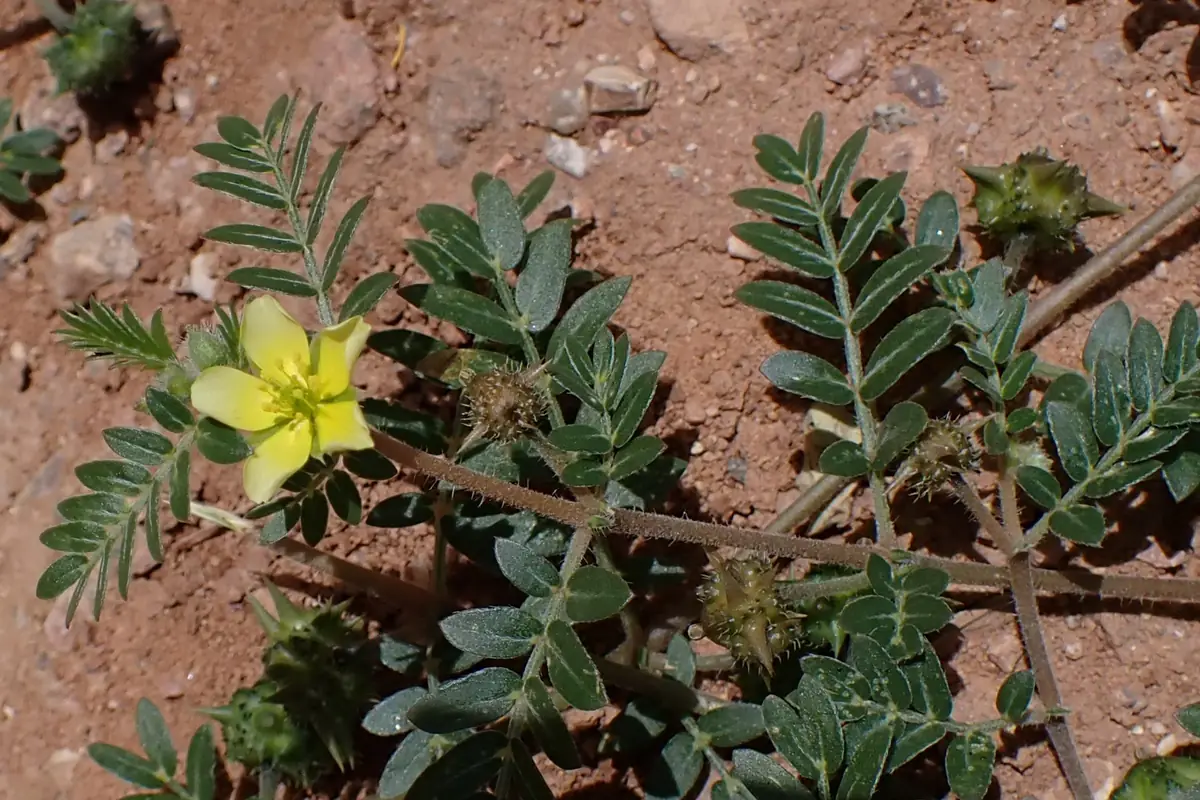
Photo: Krzysztof Ziarnek (Kenraiz), CC BY-SA 4.0, via Wikimedia Commons

To get rid of goatheads, kill the plants while they are small and before they flower, pick up any burrs already on the ground, and then stop next year's crop with a pre-emergent applied before the seed sprouts in spring. Goathead (puncturevine, Tribulus terrestris) can start flowering within about three weeks of sprouting, and its seed can stay alive in the soil for years, so one spraying almost never ends it. Plan on at least two or three seasons of follow-up on a badly infested pad or lease road (UC IPM).
How to tell it is goathead
Goathead is a summer annual that grows flat along the ground in mats that can reach 2 to 5 feet across. The leaves are split into small paired leaflets, the flowers are yellow with five petals and up to about half an inch wide, and each flower becomes a seedpod of five flat, spiny burrs. As the pod dries it turns tan, gets hard and breaks apart. Those burrs are what hurt: UC IPM notes they can injure people, pets and livestock and can even puncture bicycle tires (UC IPM).
Texas A&M's range plant guide lists goathead throughout Texas except the Gulf Coast and far East Texas, so it is at home on West Texas caliche and red dirt (Plants of Texas Rangelands).
Do not confuse it with grassbur (field sandbur). Grassbur also makes painful burrs, but it is a grass. Broadleaf herbicides that kill goathead will not touch it, so it needs a different plan (Texas A&M AgriLife).
Why it takes over pads and lease roads
Goathead does well on the kind of ground oilfield work leaves behind: open, compacted, sunny and disturbed. Texas A&M notes that disturbing the soil can make an infestation worse in the short term. The burrs also ride out on tires, boots and animals (UC IPM), which is why you often see the heaviest stands at pad entrances, along the edges of lease roads and around tank battery gates, where trucks turn and crews walk.
A typical plant makes 200 to 5,000 seeds in a season, and UC IPM says those seeds can stay viable for up to five years. New Mexico State University puts dormancy at about five to seven years (NMSU). Either way, the seed bank outlasts any single treatment.
What works at each stage
| Stage | What works | What to avoid |
|---|---|---|
| Before it sprouts (late winter to spring) | A labeled pre-emergent applied before germination | Waiting until you see plants |
| Small plants, no flowers | A labeled post-emergent herbicide, hoeing or hand pulling | Mowing; the plant grows so flat that a blade passes over most of it |
| Flowering | Treat or pull right away; seed is coming | Leaving it "for the next round" |
| Burrs forming or dropped | Remove plants and bag them; sweep up loose burrs | Blading or dragging the area, which moves burrs around; UC IPM warns burrs spread on shoes and wheels |
| Fall and first freeze | Map where it grew and plan the pre-emergent | Assuming frost solved it; the seed is still in the ground |
Sources: UC IPM; NMSU. UC IPM notes the plant cannot tolerate freezing, which is why it dies back each winter and returns from seed.
Herbicide options
Post-emergent. UC IPM lists 2,4-D, dicamba and glyphosate as the post-emergent options that work best on young plants, and Texas A&M says most broadleaf herbicides control goathead easily. Small plants are the key. Once a mat is large and setting burrs, a spray can kill the plant and still leave a crop of seed behind.
Pre-emergent. UC IPM lists oryzalin, benefin and trifluralin as giving partial control when applied from late winter to midspring, before seed germinates. NMSU times the pre-emergent for mid-March to early April in southern New Mexico, when soil reaches about 60 to 65°F. Those products carry turf and landscape labels. On a pad or lease road you want kept bare, a soil-residual bare-ground product may be the better tool; our bare ground herbicide guide covers how those work and where not to use them.
Whatever you use, the label is the law. It sets the sites, rates, timing and any grazing restrictions.
Skip the vinegar. NMSU points out that household vinegar is not labeled as an herbicide. Use a product labeled for the site instead.
Watch for livestock
Many West Texas leases share the surface with cattle, sheep or goats. Texas A&M lists goathead as toxic to sheep, where it can cause photosensitization, and notes it can build up nitrate. It also cautions that 2,4-D can raise nitrate levels in the plant, which matters where animals graze treated stands. Follow the label's grazing rules and talk to the landowner before spraying pastures next to the location.
Hand removal and tillage
On small patches, hand pulling or hoeing works if you do it before flowering and you pick up the burrs that fall off. UC IPM recommends removing seedlings and older plants by hand or hoe and keeping at it for several years. Shallow tillage, about one inch deep, kills seedlings over larger areas. Deeper tillage just buries seed that can come back up later.
Two weevils that feed on goathead seed and stems were introduced into the United States in 1961. UC IPM calls them very effective where they are established, with resurgences every few years as weevil numbers fall, and it does not generally recommend buying and releasing them because weevils from elsewhere may not survive. Treat them as a bonus, not a plan for a working pad.
Who can spray it
If someone is paid to spray goatheads, Texas requires a commercial applicator license from the Texas Department of Agriculture. TDA says a license is needed to apply any pesticide, including herbicides, to weeds for hire (TDA). Oilfield sites fall under Category 5, which covers industrial sites including oil field sites (TDA categories), and the applicator must keep application records under 4 TAC §7.33.
A one-year goathead plan for a pad
- Late winter: apply a pre-emergent or bare-ground product where it grew last year, per the label.
- Spring: scout the entrance, the edges and the road shoulders every couple of weeks once it warms up.
- First sprouts: spray or hoe while the plants are small and before the first yellow flowers.
- Summer: keep checking. New flushes come after rain.
- Any time you see burrs: bag the plants and sweep up the burrs instead of blading them, and knock burrs off tires and boots before moving to a clean location.
- Fall: note where it came back so next year's pre-emergent goes in the right places.
For the bigger picture on keeping a lease clean, see oilfield lease weed control and tumbleweed control.
Goatheads taking over a pad, battery or lease road? We are TDA-licensed and spray oilfield locations across the Permian Basin.
Get a weed control quoteFAQ
What kills goatheads permanently?
Nothing does in one pass. Kill young plants before they flower with a labeled post-emergent herbicide or by hoeing, apply a pre-emergent before seed sprouts the next spring, and repeat for several seasons. The seed can stay alive in the soil for about five years or more.
When should I spray for goatheads?
Spray small plants before they flower; they can flower within about three weeks of sprouting. For pre-emergent control, apply in late winter to spring before germination. NMSU times it for mid-March to early April in southern New Mexico, when soil reaches about 60 to 65°F.
Does mowing get rid of goatheads?
Not well. Goathead grows flat along the ground, so a mower blade passes over most of the plant and does nothing about burrs already on the ground.
Will vinegar kill goatheads?
Household vinegar is not labeled as an herbicide, according to NMSU. Use a product labeled for the site, or remove plants by hand before they set burrs.
Is goathead the same as grassbur or sandbur?
No. Goathead is a broadleaf plant. Grassbur (field sandbur) is a grass, so broadleaf herbicides that control goathead will not control it.
Do you need a license to spray goatheads for someone else in Texas?
Yes. Applying any pesticide to weeds for hire requires a Texas Department of Agriculture commercial applicator license. Oilfield sites fall under Category 5.