
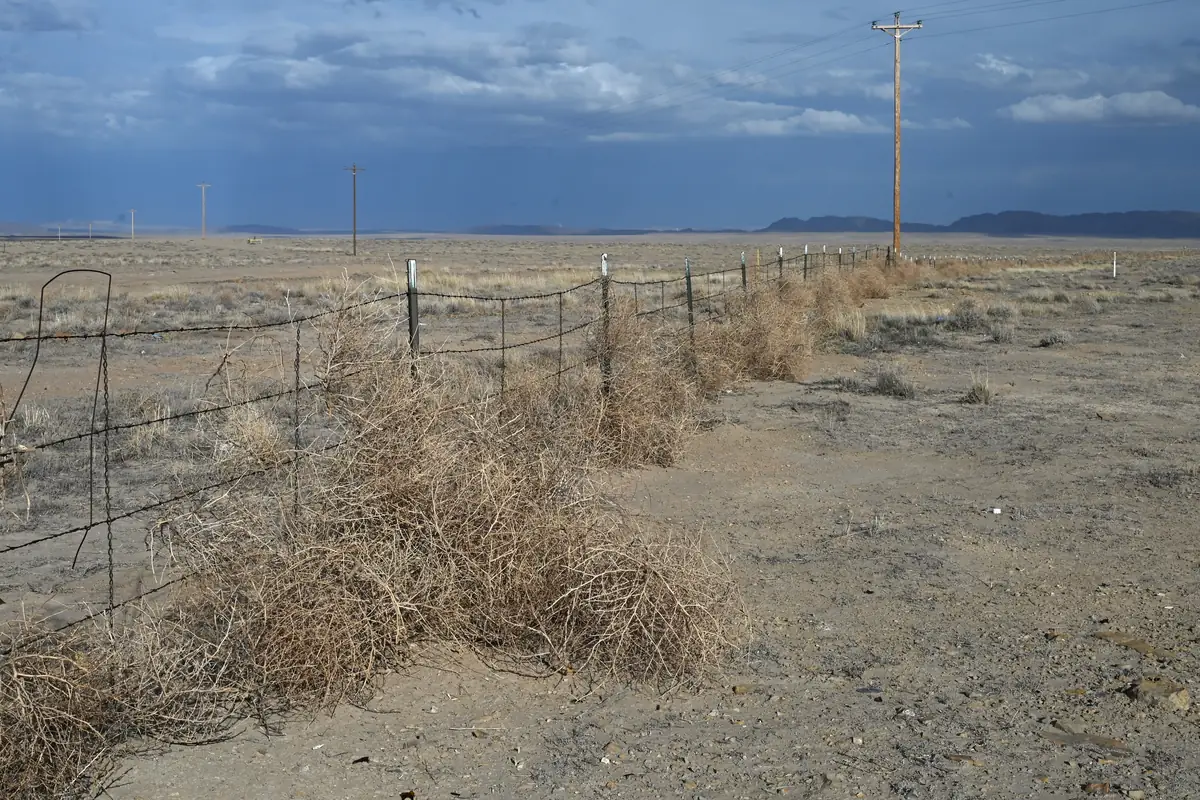
Photo: Krzysztof Ziarnek (Kenraiz), CC BY-SA 4.0, via Wikimedia Commons

A tumbleweed is a dead kochia or Russian thistle plant that has snapped off at the base and is rolling in the wind, dropping seed as it goes. Both are summer annuals that grow only from seed (Colorado State University Extension). So the way to get rid of tumbleweeds is to kill the plants while they are small and green in spring and early summer, keep them from setting seed, and pull the dry ones off fences, tanks and firewalls before they spread more.
Once a plant has dried and broken loose, herbicide does nothing for you. The seed is already on its way to the next fence line.
Two weeds, one problem
| Kochia | Russian thistle | |
|---|---|---|
| Looks like | Gray-green, fuzzy leaves; bushy, cone-shaped plant that can top 6 ft | Narrow, spine-tipped leaves; red- or purple-striped stems; up to about 3 ft |
| Comes up | Often from March, in several flushes, the last ones August to early September | Spring through summer, fast after even a light rain |
| Seed | Thousands per plant | Around 150,000 on an uncontrolled plant in open ground; viable for less than a year |
| Main herbicide problem | Resistance in Texas to some common products | Timing: best sprayed in spring while it is growing fast |
Sources: CSU Extension, Texas A&M AgriLife, Oregon State University Extension, USDA Forest Service.
The short seed life of Russian thistle is good news: a site where nothing is allowed to go to seed gets cleaner fast. Kochia comes back in more flushes, so it takes steadier follow-up.
Why pads, roads and fence lines grow them
Both weeds move into bare, disturbed ground and do poorly where other plants crowd them. Russian thistle seedlings are weak competitors and do not establish well in crowded plant communities (USDA Forest Service). A scraped location, a lease road shoulder or a pipeline right-of-way is exactly that kind of ground.
Russian thistle needs very little water to get going. Oregon State reports large emergence after rains of about 0.1 inch on dry soil, with the best emergence from seed less than an inch deep. The same publication notes that compacted soil holds it back, because the uncoiling root cannot push in, though seedlings still come up through cracks (OSU). That is why a hard caliche pad often stays cleaner in the middle than along its loose edges and berms. Goatheads favor the same ground; see our goathead guide.
Then the wind does the rest. Cornell's weed profile cites research in which Russian thistle plants rolled an average of about 2,078 yards, and as far as 2.5 miles, before a fence or road stopped them (Cornell CALS). Texas A&M AgriLife describes the same pattern with kochia: plants hang up on fence lines, drop seed, and start a patch along the edge that spreads from there.
When to spray
- Spring into early summer, while plants are small. CSU says herbicides work best on kochia at about 2 to 6 inches tall, not on tiny fuzzy seedlings with little leaf surface. Its hairy leaves are why labels and extension guides call for a surfactant. For Russian thistle, CSU recommends spraying in spring while plants are growing fast.
- After every rain that brings a new flush. Kochia comes up in waves through late summer, so one spring pass rarely finishes the year.
- Before seed set, not after. AgriLife's agronomist points out that most kochia branches have their own growing point. A spray that only burns the plant back still lets lower branches make seed, and partial control feeds resistance.
- After the first hard freeze, the plants are done. Oregon State notes that the first killing frost ends viable seed production. From then on the job is removal, plus residual (pre-emergent) treatment on ground you want bare. Our lease and pad weed control guide covers bare-ground programs.
Kochia that will not die
If glyphosate worked on a site a few years ago and now leaves kochia standing, resistance is a likely reason. Kochia resistant to ALS-inhibiting herbicides (HRAC Group 2, such as metsulfuron) was first documented in Texas in 1998 (International Herbicide-Resistant Weed Database). A study of 82 kochia populations from western Kansas, western Oklahoma and the Texas High Plains found Texas populations with low-level resistance to glyphosate and dicamba, the first such report for Texas (Weed Science). AgriLife has reported High Plains growers with control failures from glyphosate, dicamba, metsulfuron and fluroxypyr.
What the extension guidance says to do about it:
- Use more than one herbicide mode of action, and add residual products, instead of relying on one product year after year (AgriLife).
- Do not count on 2,4-D for kochia. CSU lists it as not effective on kochia, though it does control Russian thistle.
- Where both weeds grow together, CSU suggests mixes such as dicamba plus 2,4-D or dicamba plus fluroxypyr.
- Kill the field edges, roadsides and fence lines too, so they stop reseeding the site (AgriLife).
The label is the law on rates, sites, grazing limits and protective gear, so we do not list rates here. In Midland County and several nearby counties, 2,4-D and dicamba are also Texas Department of Agriculture regulated herbicides, with permit and wind rules on top of the label. Our pipeline right-of-way guide lists which counties and what the rules require.
Clearing the dry ones
CSU's advice is simple: pull tumbleweeds off fence lines, and collect and dispose of plants that have already made seed so they do not add to the seed in the soil. Mowing is a weak tool. Kochia keeps making seed on branches below the mower, and Russian thistle can regrow if it is mowed at the wrong time.
On a lease, piled tumbleweeds are also dry fuel against tanks, separators and firewalls. Texas Railroad Commission Rule 21(i) requires rubbish or debris that might be a fire hazard to be removed to at least 150 feet from any well, tank or pump station, and waste to be burned or disposed of in a way that does not create a fire hazard (16 TAC 3.21). Whether an inspector treats a given pile as debris is up to the district office, but a battery wrapped in dead weeds is an easy write-up to avoid.
If cattle graze the lease
Kochia can carry nitrates, oxalates and other compounds at levels that poison cattle and sheep, and the risk rises as the plant matures or is drought-stressed. Russian thistle can build up toxic nitrate levels (CSU). Tell your applicator when livestock are on the lease, because herbicide labels set grazing restrictions.
A year on one lease
- March to June: check pads, road edges and fence lines after rains and spray small plants.
- June to August: treat new flushes and anything missed, with a different mode of action where kochia survived.
- Late summer: do not let anything flower and seed. Spot spray or pull.
- After the first freeze: clear dry plants from fences, cattle guards, tanks and firewalls and haul them off.
- Late fall to winter: put down residual products on areas that should stay bare.
How we help
Simba Services sprays leases, pads, tank batteries, roads and fence lines around Midland, Odessa and the Permian Basin under a Texas Department of Agriculture commercial applicator license. We pick and rotate products for what is growing on the site and what the label allows, and we keep application records. If you are pricing a job yourself first, our spray acreage and herbicide mix calculator works out acres and tank mixes.
Tumbleweeds stacking up on your fence lines and tanks? Send the leases or a map and we will put them on a spray schedule.
Get a weed control quoteFAQ
What is a tumbleweed?
A dead, dried plant that breaks off at the base and rolls in the wind, dropping seed. In West Texas it is usually Russian thistle or kochia. Both are annuals that spread only by seed.
When is the best time to kill tumbleweeds?
In spring and early summer while the plants are small and green. CSU Extension says kochia is easiest to control at about 2 to 6 inches tall. Once a plant has dried and broken loose, spraying it does nothing.
Does 2,4-D kill kochia?
Not reliably. Colorado State University Extension lists 2,4-D as not effective on kochia, although it controls Russian thistle. Products and mixes need to fit the weed and the label.
Why didn't glyphosate kill the kochia?
Plants that were too large or already setting seed are hard to kill, and some Texas kochia has low-level resistance to glyphosate and dicamba. Rotating modes of action and adding residual products helps.
Can you just mow tumbleweeds?
Mowing is a weak option. Kochia keeps making seed on branches below the mower, and Russian thistle can regrow if mowed at the wrong time. Spraying young plants and clearing dry ones works better.
Do tumbleweeds have to be cleared away from oil tanks?
RRC Rule 21(i) requires rubbish or debris that might be a fire hazard to be kept at least 150 feet from wells, tanks and pump stations. Dry tumbleweed piles against tanks are fuel, so clearing them is good practice.