
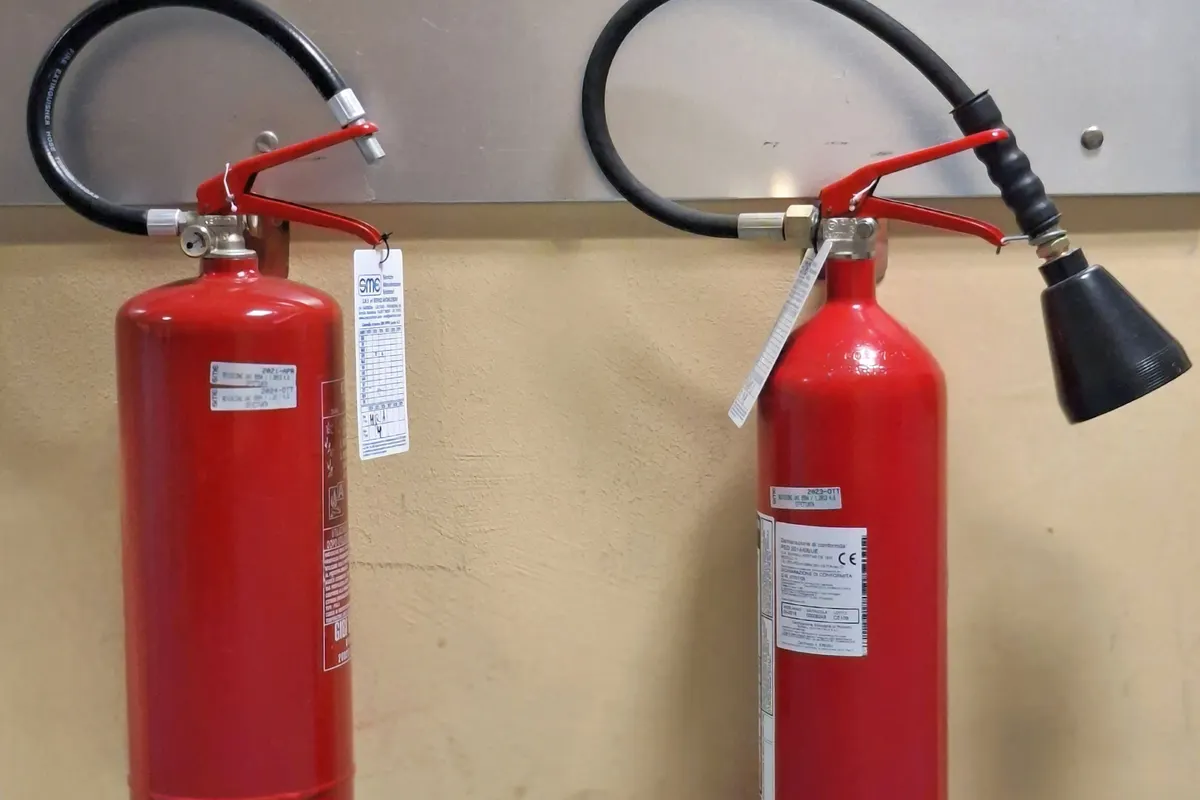
Photo: Anna.Massini, CC BY 4.0, via Wikimedia Commons

Texas businesses, including oilfield yards and lease sites, have two sets of extinguisher rules to follow. OSHA sets what the employer must do. The Texas State Fire Marshal's Office sets who may service extinguishers and how the work is tagged. Both point back to NFPA 10, the national standard for portable fire extinguishers.
The short answer
- Monthly: a quick visual inspection, which your own people can do.
- Every year: a maintenance check, recorded on a tag or record.
- Every 6 or 12 years and at hydrostatic test intervals: internal maintenance and pressure testing, depending on the extinguisher type.
- In Texas: service must be done by a firm registered with, and a technician licensed by, the State Fire Marshal's Office, and it must leave a service tag.
What OSHA requires of employers
Under 29 CFR 1910.157(e), an employer that provides portable extinguishers must visually inspect them monthly, have each one go through maintenance at least once a year, and record the annual maintenance date. That record must be kept for one year after the last entry or for the life of the shell, whichever is less. The same section requires hydrostatic testing at the intervals in its Table L-1 (OSHA 1910.157).
What NFPA 10 adds
NFPA 10 sets out what each check involves. The monthly inspection looks at things like:
- The extinguisher is in its place and easy to see and reach
- The pressure gauge, if there is one, reads in the operable range
- The pin and tamper seal are in place
- There is no obvious damage, corrosion, leakage or clogged nozzle
The annual maintenance is a closer look by a qualified person. Stored-pressure dry chemical extinguishers that need a 12-year hydrostatic test also need internal maintenance every 6 years. Hydrostatic test intervals depend on the type; see the table below, and check the label and the current edition of NFPA 10 for your units.
What Texas adds
Texas Insurance Code Chapter 6001 puts the State Fire Marshal's Office in charge of leasing, selling, installing and servicing portable fire extinguishers. Its rules are in 28 TAC Chapter 34, Subchapter E. Key points:
- Texas adopts NFPA 10 by reference. The edition listed in 28 TAC §34.507 is the one that applies (TDI adoption order).
- Extinguishers must be installed, serviced and maintained per the manufacturer's instructions and the adopted standards, and the licensee must attach a service tag when the work is done (28 TAC §34.517).
- A new tag goes on each time service is performed, and the licensee's signature certifies the work (28 TAC §34.520).
Your city or county fire marshal may also adopt its own fire code, so check locally.
Hydrostatic test intervals
OSHA's Table L-1 sets how often each type of shell must be pressure tested (1910.157(f)):
| Type | Test interval |
|---|---|
| Stored-pressure water, carbon dioxide, AFFF foam, wet chemical | 5 years |
| Dry chemical, stainless steel shell | 5 years |
| Dry chemical, stored pressure, mild steel, brazed brass or aluminum shell | 12 years |
| Halon 1211 and 1301 | 12 years |
The employer must keep a certification record of each test with the date, the signature of the person who did it, and the extinguisher's serial number or other identifier, until the next test or until the unit is taken out of service. While a unit is out for service, OSHA requires alternate protection in its place.
How many and where
Inside buildings, OSHA's general industry rule limits travel distance to an extinguisher: no more than 75 feet for Class A (ordinary combustibles) and 50 feet for Class B (flammable liquids) (1910.157(d)). Those distance rules do not apply to extinguishers provided outside buildings, so on an open lease the operator's program and the local fire code set the placement. Extinguishers still have to be kept charged, in their place, and easy to reach.
Construction sites have their own rule: at least one 2A extinguisher for every 3,000 square feet within 100 feet of travel, and a 10B extinguisher within 50 feet of where more than 5 gallons of flammable or combustible liquid or 5 pounds of flammable gas are in use (1926.150(c)).
Trucks
Federal motor carrier rules require each power unit to carry a fire extinguisher rated 5 B:C, or two rated 4 B:C. Trucks placarded for hazardous materials need one rated 10 B:C. The extinguisher must be securely mounted, have a gauge or other way to show it is charged, and use an agent that will not freeze (49 CFR 393.95). A DOT inspection will check it, so add truck units to the monthly walk-around.
On a lease or yard
Field units get dust, heat and sun. Monthly checks catch a low gauge, a missing pin or a unit buried behind equipment. Keep the monthly record simple: date and initials on the tag or a log. Book the annual service with a licensed Texas firm, and keep their tags and records together.
Train the people who use them
OSHA 1910.157(g) also requires employers to train employees who are expected to use extinguishers, when they are first hired and every year after. Simba Services does not service extinguishers. We teach H2S and First Aid/CPR/AED for oilfield and data center crews, and can teach at your site. For remote locations, see OSHA first aid requirements for remote sites.
Have a question about your yard or lease site? Send it through our contact form.
Contact usFAQ
How often do fire extinguishers need to be inspected in Texas?
Visually once a month, and maintained once a year by a licensed technician who attaches a Texas service tag. Some types also need 6-year internal maintenance and periodic hydrostatic tests.
Who can service fire extinguishers in Texas?
A firm registered with the Texas State Fire Marshal’s Office, using a technician who holds a State Fire Marshal extinguisher license.
Can my own employees do the monthly check?
Yes. The monthly visual inspection can be done by trained employees. Record the date and initials.
Which edition of NFPA 10 does Texas use?
The edition listed in 28 TAC §34.507. Check the current rule, since TDI updates it from time to time.
How often do fire extinguishers need a hydrostatic test?
Every 5 years for water, CO2, foam, wet chemical and stainless steel dry chemical units, and every 12 years for most stored-pressure dry chemical and Halon units, per OSHA Table L-1.
What fire extinguisher does a commercial truck need?
One rated 5 B:C or two rated 4 B:C, securely mounted, or 10 B:C if the truck is placarded for hazardous materials, under 49 CFR 393.95.