
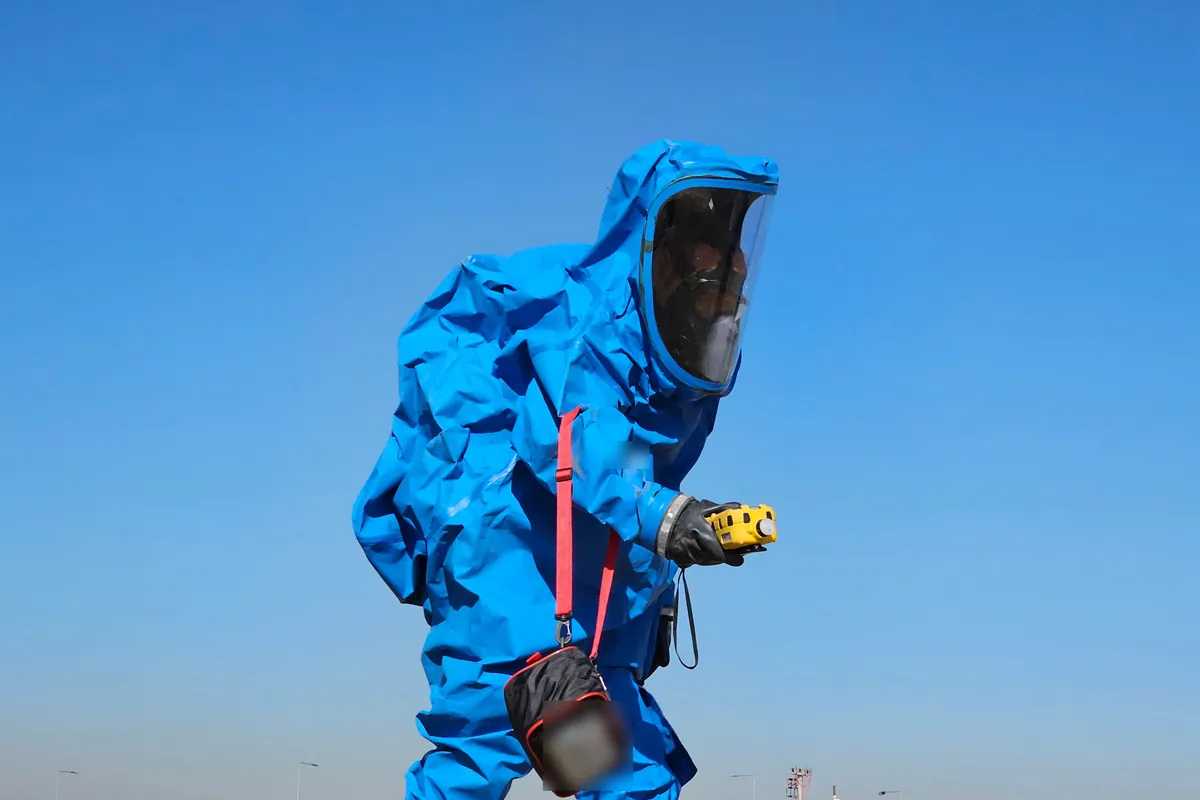
Bump test a personal H2S monitor before each day's use. That is the recommendation of the International Safety Equipment Association (ISEA), the trade group for gas monitor makers, and OSHA's bulletin on gas monitors repeats it: run a bump test or a calibration check before each day's use, following the manufacturer's instructions (OSHA SHIB, ISEA statement). A bump test only proves gas can reach the sensor and the alarms go off. It does not prove the reading is accurate. If the monitor fails a bump test or calibration check, do a full calibration before using it. If it fails the full calibration, take it out of service.
Three checks, three different jobs
People use "bump" and "calibrate" as if they meant the same thing. OSHA's bulletin describes three separate checks:
| Check | What you do | What it proves |
|---|---|---|
| Bump test (function check) | Pass enough challenge gas over the sensor, for long enough, to set off every alarm. | Gas gets to the sensor and all the alarms work. It says nothing about accuracy. |
| Calibration check | Zero the unit, apply test gas, and compare the reading with the concentration on the cylinder. | The reading is within the maker's tolerance, typically ±10–20% of the test gas. Check the manual for your unit's range. |
| Full calibration | Adjust the monitor so its reading matches a certified test gas traceable to NIST. | It resets the reference point the sensor measures against. |
For a calibration check, the test gas should be strong enough to trigger the alarms too, so one check covers both the alarms and the accuracy.
How often to do each
- Before each day's use: a bump test or a calibration check.
- Failed bump test or calibration check: a full calibration before the monitor goes back to work.
- Failed full calibration: take it out of service and contact the manufacturer.
- After anything that can throw it off: check it again (see the list below).
The ISEA calls daily verification a minimum, with more testing as needed. Your monitor's manual, company policy and the operator's site rules can all require more. OSHA recommends a written procedure that follows the manufacturer's instructions, company policy and any agency guidelines that apply.
What makes a monitor drift
All sensors drift over time. A drifting monitor still detects gas, but its number is no longer reliable. OSHA lists the common causes:
- Normal aging of the sensor and electronics
- Extreme heat, cold or humidity, and heavy dust in the air
- Exposure to high concentrations of the gas it detects
- Solvent vapors and highly corrosive gases, which affect electrochemical toxic-gas sensors
- Silicones, hydride gases, halogenated hydrocarbons and sulfide gases, which affect catalytic LEL sensors
- Drops and vibration over time
OSHA says to verify the monitor whenever one of these happens, or might have happened, during use. In sour country, that sulfide line matters: if your multigas monitor uses a catalytic LEL sensor, H2S exposure can affect that sensor too, not just the H2S reading. After a high H2S alarm, bump or check the whole unit before trusting it again. A monitor can look fine and still be damaged inside, so a dropped unit gets checked even when the case is not cracked.
The gas and the setup matter
- Use certified gas, before it expires. The supplier should provide a certificate of analysis for every cylinder. OSHA warns that reactive gases such as H2S stay stable for only a limited time, so never use an expired cylinder.
- Use the right parts. The gas type and concentration, the tubing, the regulator and the calibration cap are all part of the result. Use what the manufacturer specifies.
- Test where you work. Sensor response changes with temperature, humidity and pressure. OSHA says to check monitors in conditions as close as possible to the work site. A unit stored in an air-conditioned cab and used on a hot pad should be checked outside, not in the office.
- Train the people doing it. OSHA says employers should train and test everyone responsible for calibration.
A daily bump test, step by step
Your manual and docking station, if you have one, come first. A typical manual bump test goes like this:
- Check the cylinder: the right gas mix and concentration for the unit, and not expired.
- Turn the monitor on in clean air and let it finish its startup self-test. Zero it if the manual calls for it.
- Fit the calibration cap, open the regulator and apply gas for the time the manual gives.
- Confirm every alarm the unit has goes off: sound, light and vibration.
- Remove the gas and let the readings clear before you head out.
- Log the result. If it failed, do a full calibration or pull the unit.
Keep the records
OSHA recommends keeping calibration records for the life of each monitor. The records show which unit keeps needing repair or gives erratic readings, and how much a sensor has drifted, so you can tell when it is due for replacement. They also answer the first question asked after an incident: when was this unit last checked?
Where a calibrated instrument is required
OSHA's bulletin is guidance. It is not a standard and creates no new legal obligations. Some OSHA standards do require a calibrated instrument for specific tasks. For example, before a permit-space entry under the alternate procedures in the confined space standard, the atmosphere must be tested with a calibrated direct-reading instrument. It is tested in this order: oxygen, then flammable gases and vapors, then toxic air contaminants (29 CFR 1910.146(c)(5)(ii)(C)). For the H2S levels behind your alarm set points, see what level of H2S is dangerous.
How we help
Our H2S safety class is held at the Simba yard, 9507 FM 307, Midland, TX 79706, and follows ANSI Z390.1. Students work hands-on with a monitor, including a bump test and an escape pack, then take a written test. Bring a photo ID. To see what the class covers, read H2S training in Midland: what to expect. For a crew, we can also bring the class to your location; see on-site safety training. If you are not sure which card your operator wants, see H2S awareness vs. H2S Clear.
Need your crew trained on monitors, bump tests and escape packs? Book a seat or a group class.
Book H2S trainingFAQ
How often should you bump test an H2S monitor?
Before each day's use, following the manufacturer's instructions. That is the ISEA recommendation, and OSHA repeats it. Test again after a drop, a high-gas exposure or harsh conditions.
Is a bump test the same as a calibration?
No. A bump test only confirms gas reaches the sensor and the alarms work. A calibration check compares the reading with the test gas, and a full calibration adjusts the monitor to match certified gas.
What should I do if my gas monitor fails a bump test?
Do a full calibration before using it. If it fails the full calibration, take it out of service and contact the manufacturer.
Does OSHA require a daily bump test?
OSHA's gas monitor bulletin recommends a bump test or calibration check before each day's use, but the bulletin is guidance, not a standard. Some OSHA standards, such as the confined space rule, require a calibrated instrument for specific tasks.
Can I use expired calibration gas?
No. OSHA says never to use test gas after its expiration date. Reactive gases such as H2S stay stable for only a limited time.