
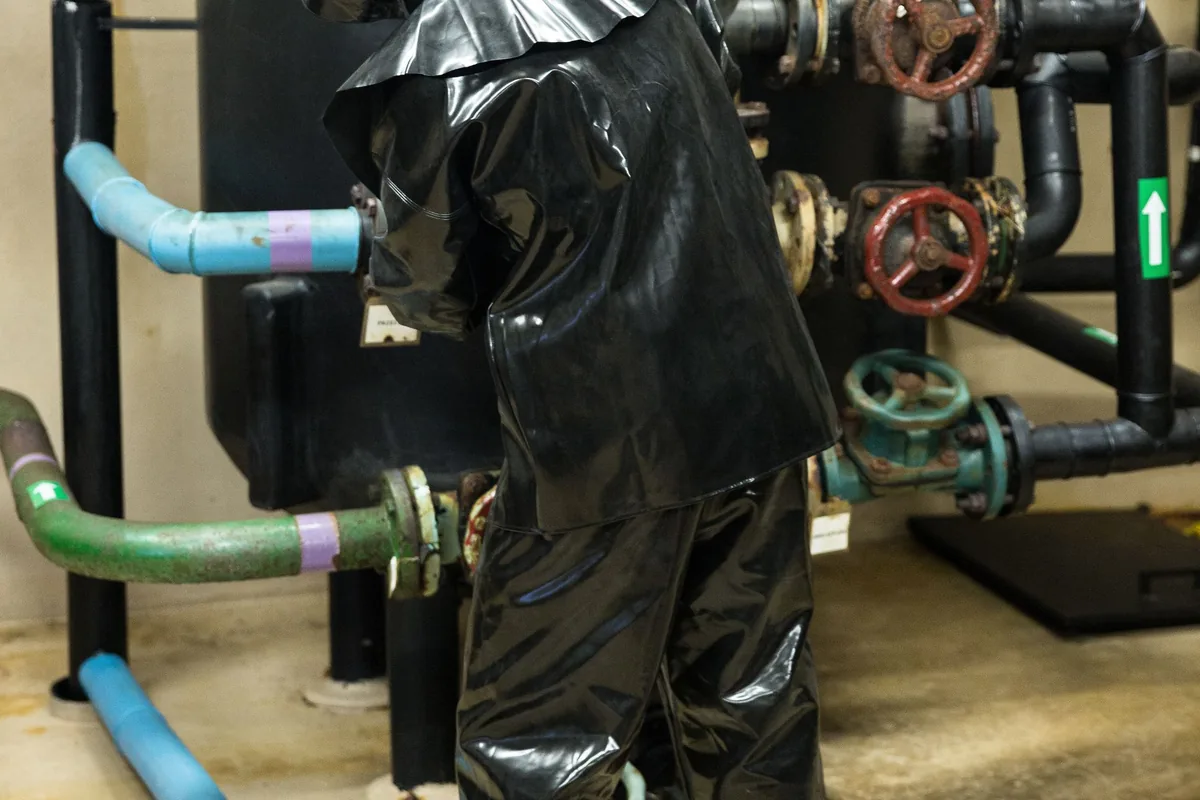
Hydrogen sulfide (H2S) is dangerous at levels far below what most people expect. NIOSH lists 100 ppm as immediately dangerous to life and health. Above about 700 ppm, a worker can collapse within one or two breaths. Below are the official limits, what each level does to the body, and the habits that keep crews out of trouble. The numbers come from OSHA's H2S hazards page and the NIOSH Pocket Guide. They do not replace a full class or your site's procedures.
Exposure limits
| Limit | Value | Type |
|---|---|---|
| OSHA general industry | 20 ppm ceiling; 50 ppm peak for up to 10 minutes if no other exposure that shift | Enforceable |
| OSHA construction | 10 ppm, 8-hour time-weighted average | Enforceable |
| NIOSH REL | 10 ppm, 10-minute ceiling | Recommended |
| NIOSH IDLH | 100 ppm | Immediately dangerous to life and health |
Sources: NIOSH Pocket Guide, OSHA annotated Table Z-2. OSHA limits are the law. The NIOSH numbers are recommendations, but many operators build their own rules on them. Note that the 10 ppm NIOSH ceiling is half the OSHA general industry ceiling.
What happens at each level
| ppm | Effects (OSHA) |
|---|---|
| 0.01–1.5 | Odor threshold, rotten egg smell |
| 2–5 | Prolonged exposure may cause nausea, tearing eyes, headaches |
| 20 | Possible fatigue, headache, irritability, dizziness |
| 50–100 | Eye and airway irritation after 1 hour |
| 100 | Coughing, eye irritation, loss of smell after 2–15 minutes |
| 100–150 | Loss of smell |
| 200–300 | Marked eye and airway irritation after 1 hour; fluid in the lungs possible with longer exposure |
| 500–700 | Staggering, collapse in 5 minutes; death after 30–60 minutes |
| 700–1,000 | Rapid unconsciousness within 1 to 2 breaths; death within minutes |
| 1,000–2,000 | Nearly instant death |
What H2S is and where it collects
Hydrogen sulfide is a colorless, flammable gas that occurs naturally in crude oil and natural gas. It is heavier than air, can travel along the ground, and collects in low or enclosed places such as cellars, pits, tanks and vaults (OSHA eTool). OSHA also notes that wells without H2S have turned sour overnight, so do not assume a location is safe because it was last week.
Do not trust your nose
Some people can smell H2S at 0.01 to 1.5 ppm. At 100 ppm, it knocks out the sense of smell within 2 to 15 minutes, and at high concentrations the smell can disappear instantly while the gas is still there (OSHA fact sheet). A worker can stop smelling it right when it is most dangerous. The monitor is the warning, not your nose.
Monitors and alarm settings
Many sites set personal monitors to alarm at 10 ppm, which matches the NIOSH ceiling, and some add a second, higher alarm. The operator's settings are the ones to follow. A few habits make a monitor worth wearing:
- Wear it in your breathing zone, such as on your collar or upper chest, not on your belt.
- Bump test and calibrate it on the schedule the manufacturer and your company set.
- Know what each alarm means on your site before you need to react to one.
- Do not silence an alarm and keep working.
Habits that matter on location
- Check wind direction on the windsocks before you start, and know your escape routes and safe briefing areas.
- Be careful opening hatches. OSHA says gas coming out of a hatch can cause knockdown faster than a meter can warn you.
- Follow confined space procedures for tanks, pits and other enclosed spaces.
- Stay upwind when you can, and move crosswind and uphill to get out of a release.
These come from the training topics OSHA lists for H2S work (OSHA eTool).
It burns, too
H2S is flammable between about 4 and 44 percent in air (NIOSH). That is far above the levels that kill, so the poisoning hazard comes first. Still, a release near an ignition source is a fire risk as well as a breathing risk. Burning H2S produces sulfur dioxide, which is also toxic, so a fire or a flare does not make the area safe.
If the alarm goes off
Follow your site's plan: leave by the planned route, go to the briefing area, and make sure everyone is accounted for. Do not run in after someone who is down. OSHA warns against attempting a rescue where H2S may be present without proper respiratory protection and training (OSHA fact sheet). H2S can overcome a rescuer just as fast as the first victim.
Texas oilfield rules
Railroad Commission Statewide Rule 36 applies to operations where H2S is above 100 ppm and requires training for workers in affected areas (16 TAC §3.36). Which course your operator accepts is covered in H2S Awareness vs. H2S Clear, and what our class covers is in H2S training in Midland.
Our 4-hour H2S class covers detection, alarms, escape and rescue.
Book an H2S classFAQ
What level of H2S is immediately dangerous?
NIOSH lists 100 ppm as immediately dangerous to life and health. Above about 700 ppm, a worker can collapse within one or two breaths.
What is the OSHA limit for H2S?
In general industry, a 20 ppm ceiling with a 50 ppm peak allowed for up to 10 minutes once per shift if there is no other measurable exposure. In construction, 10 ppm as an 8-hour average.
Can you smell H2S at dangerous levels?
Not reliably. At 100 ppm it can knock out your sense of smell within 2 to 15 minutes, and at high levels the smell can vanish instantly. Use a monitor.
Is H2S heavier than air?
Yes. It can collect in low or enclosed places such as cellars, pits, tanks and vaults.
What should you do when an H2S alarm goes off?
Follow the site plan: leave by the planned route, usually upwind or crosswind, go to the briefing area and get a headcount. Do not attempt a rescue without proper respiratory protection and training.