
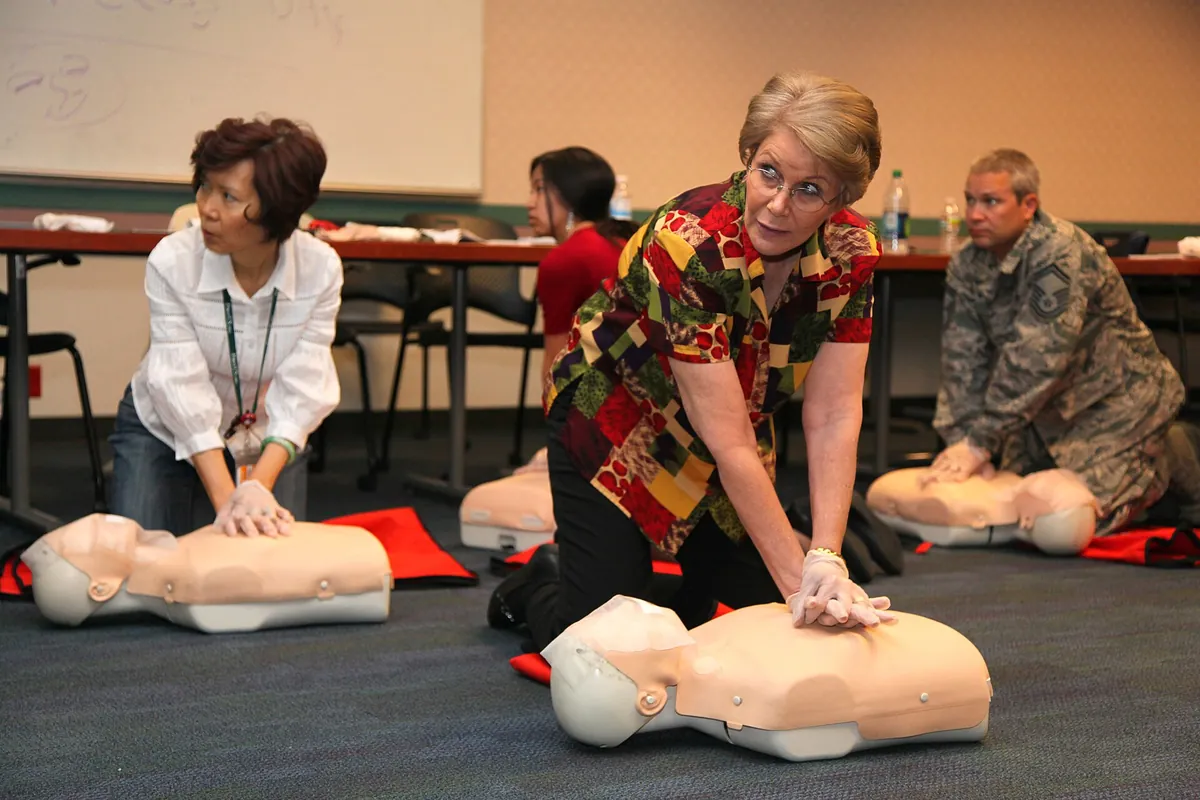
Photo: U.S. Army Corps of Engineers Sacramento District, Public domain, via Wikimedia Commons

A search for CPR classes in Midland-Odessa turns up colleges, safety training companies and online courses. This guide covers how they differ, what they cost, how long a card lasts, how to find and renew a Red Cross certificate, and what a work site should plan for beyond the card. Public price lists we checked on October 1, 2026 showed first aid/CPR/AED classes at about $75 to $125 per person.
Card types you will see
The Midland-Odessa classes we found issue cards from the American Red Cross, the American Heart Association, or HSI (Medic First Aid). Most workplace classes are a combined first aid, CPR and AED course. Healthcare jobs usually ask for a provider-level course instead, such as AHA's BLS, so check the job's wording. If your employer or an operator needs a particular card, find out before you book.
Prices in the area
Public price lists showed classes at about $75 to $125 per person. Some local colleges offer grant-funded workplace classes at no cost, with fixed dates and minimum enrollment. Group rates and on-site classes can change the math for a crew.
In person, blended or online
The Red Cross offers in-person and blended courses (online work plus an in-person skills session). Both give a two-year certification (Red Cross). Online-only courses skip the hands-on skills check. If your employer or OSHA's construction rule applies to you, make sure the course includes one.
How long a Red Cross card lasts
An American Red Cross CPR certificate is good for two years from the date you complete the course. Red Cross certificates are digital. Each has a unique ID and a QR code so an employer can confirm it is valid. You can look yours up on the Red Cross site by email address, by name and course date, or by certificate ID, or through your Red Cross Learning Center account (Red Cross certificate lookup). If you lost your card and took the class in the past three years, the Red Cross says you should be able to find it the same way.
Renewing
The Red Cross offers shorter renewal courses, marked "Review" or "Challenge," for people whose certification is still valid but close to expiring. Passing one extends the certification another two years (Red Cross renewal). Renewal courses are meant for current certificates. If yours has lapsed, do not count on a grace period; ask whether you need the full course.
Skills fade before the card does
According to the Red Cross Scientific Advisory Council, CPR skills start to decline within a few months of training, and fewer than half of participants can pass a skills test one year after training. A valid card does not mean you remember the steps. If your crew works far from help, think about how often people practice, not just when cards expire.
The workplace rules behind CPR training
OSHA's general industry rule requires someone trained in first aid when there is no clinic or hospital in near proximity (29 CFR 1910.151). OSHA reads near proximity as 3 to 4 minutes where serious injuries are possible. The construction rule, 1926.50(c), asks for a valid certificate from the American Red Cross, the U.S. Bureau of Mines, or verifiable equivalent training (OSHA interpretation). An expired card does not meet that wording. For crews on remote sites, see OSHA first aid rules for remote job sites.
Why the AED part matters
OSHA says survival from sudden cardiac arrest drops 7 to 10 percent for each minute without CPR or defibrillation, and after 10 minutes resuscitation rarely succeeds (OSHA AED page). OSHA standards do not specifically require AEDs, but OSHA encourages them. An AED only helps if people nearby know where it is and are willing to use it.
Data center and construction crews
Data center sites in West Texas combine construction, heavy equipment and electrical work, and some are a long drive from town. Our West Texas data center map shows where they are. On a site that runs more than one shift, or where crews are spread across a large building, plan for trained people on every shift and in each work area. Settle these on site too:
- Where the AEDs and first aid kits are, and who checks them
- The site address and directions to give a 911 dispatcher
- Who meets EMS at the gate
For employers
- Keep each person's certificate ID and expiration date in one place.
- Schedule renewals a month or two early.
- Train people together where you can, so renewals line up.
H2S cards usually renew every year, so if your crew needs both, the dates will not match. See H2S training in Midland.
What we offer
- American Red Cross First Aid/CPR/AED, 2 hours, 2-year card, with CPR manikins and AED trainers
- Thursdays 1 to 3 PM in Greenwood, Texas, after the morning H2S class
- $95 per person, or $80 each for groups of 4 or more
- Saturdays: H2S and First Aid/CPR/AED together, 8 AM to 5 PM, $199 or $170 each for 4 or more
- At your site on any day, up to 10 people per class
Questions to ask any provider
- Which organization issues the card, and how long is it valid?
- Does the class include first aid and AED, or CPR only?
- Is there an in-person skills check?
- When will I get my card?
- Do you offer group pricing or on-site classes?
Need a Red Cross CPR card? Take the Thursday class in Greenwood or set a date at your site.
Book a CPR classFAQ
How much does CPR certification cost in Midland?
Public price lists we checked ranged from about $75 to $125. Our Red Cross First Aid/CPR/AED class is $95, or $80 each for 4 or more.
How long is a Red Cross CPR card good for?
Two years from the date you complete the course.
Is there a grace period after it expires?
Do not count on one. Red Cross renewal courses are designed for people whose certificates are still valid.
Where can I find my Red Cross certificate?
Search the Red Cross certificate lookup by email, by name and course date, or by certificate ID.
Does OSHA require AEDs at data centers?
OSHA standards do not specifically require AEDs, but OSHA encourages them in workplaces.
Can you teach CPR at our site?
Yes. We teach at your site on any day, up to 10 people per class.