
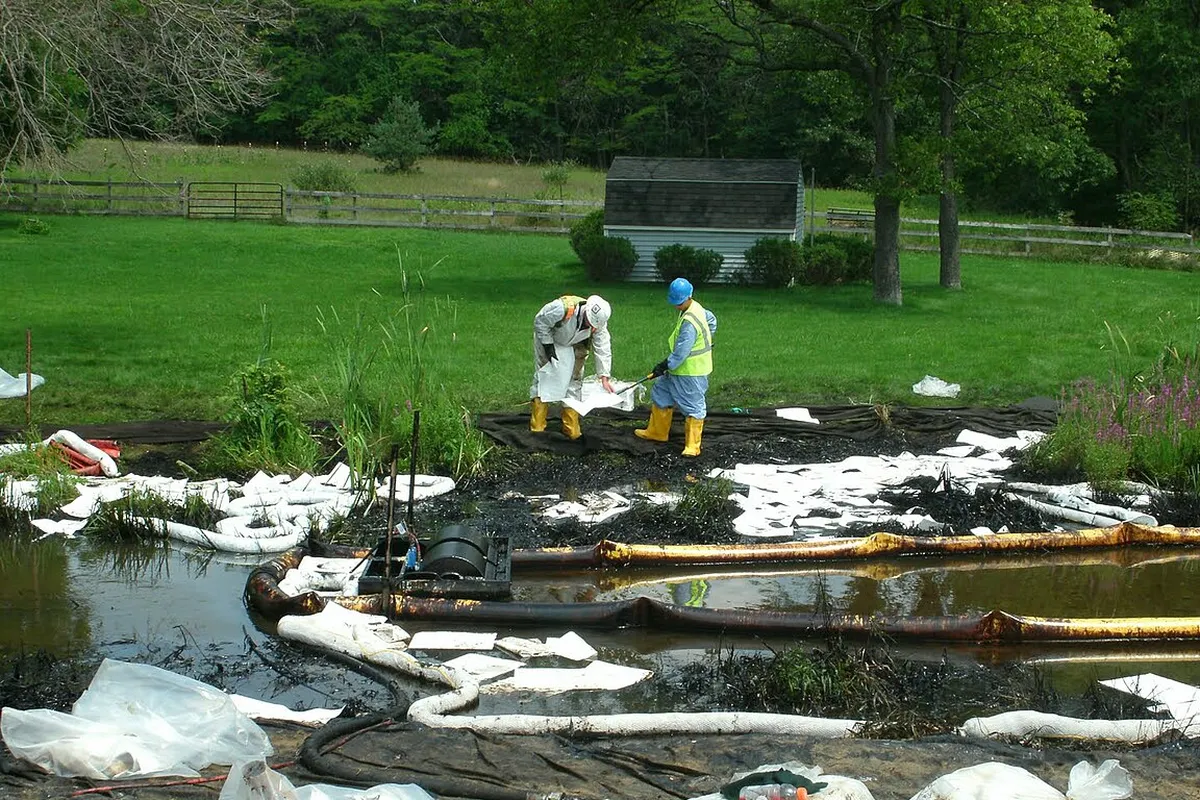
Photo: U.S. EPA, public domain, via Wikimedia Commons

On a Texas oil lease, spill cleanup falls under the Railroad Commission of Texas (RRC), not TCEQ. Two statewide rules do most of the work: Rule 20 says who to notify and when, and Rule 91 sets the cleanup standard for crude oil on soil. The short version: tell the RRC district office right away, remove free oil immediately, and clean the soil to 1.0% total petroleum hydrocarbons (TPH) within one year. File a report if more than 5 barrels were lost. This guide walks through both rules and what to have ready when you call a cleanup crew. It is a plain-language summary, not legal advice; the rule text controls.
Step one: notify the district office (Rule 20)
Statewide Rule 20 requires the operator to give immediate notice of a fire, leak, spill or break to the RRC district office by phone, followed by a letter. The letter gives the full description of the event, including the volume of crude oil, gas or other well liquids lost, the location by county, survey and property, and the steps taken or under way to fix the situation. If the volume is an estimate, the report should say so. Tank overflows are reported the same way as leaks. The oil-loss report is required only when the loss is more than 5 barrels in total (16 TAC §3.20).
Midland and Ector counties, and much of the Permian Basin, are in RRC District 08, which has its office at 10 Desta Drive in Midland. Check the RRC locations page for the district that covers your county.
What Rule 91 covers
Statewide Rule 91 sets the cleanup standard for soil contaminated by crude oil spills in non-sensitive areas, from exploration and production operations, including transportation (16 TAC §3.91). It does not cover:
- Condensate. Hydrocarbon condensate spills are handled separately with the district office.
- Sensitive areas. The RRC defines these by things like shallow groundwater, nearby surface water (creeks, including dry ones, stock tanks, water wells, wetlands), wildlife refuges or parks, and nearby homes or businesses (16 TAC §4.110). Cleanup there is set case by case with the district office.
- Old contamination. Oil that was spilled before the rule took effect in 1993 is also handled case by case.
A spill into water of any size must be reported.
The cleanup steps under Rule 91
- Remove free oil right away. Oil the soil has not absorbed must be removed immediately for reclamation or disposal, to keep it from soaking in deeper.
- Delineate the spill. Find how far the soil above 1.0% TPH by weight goes, both across the surface and down.
- Excavate. Dig out all soil above 1.0% TPH.
- Deal with heavily oiled soil quickly. Soil above 5.0% TPH must right away be mixed in place to 5.0% or less, hauled to an approved disposal site, or put in secure interim storage. Plastic under and over the pile counts as secure.
- Finish to 1.0% TPH. Final cleanup must reach 1.0% TPH as soon as technically feasible, and no later than one year after the spill.
Bioremediation on site is allowed if the soil is mixed evenly to no more than 18 inches deep and no more than 5.0% TPH. Any other method needs the Commission's written approval.
Reporting by spill size
| Crude lost | What Rule 91 requires |
|---|---|
| 5 barrels or less | Clean up to the same standard. No report, unless it reached water. |
| More than 5 barrels | Rule 20 notice, plus Form H-8 to the district office |
| More than 25 barrels | All of the above, plus a final report with analyses of representative samples |
The Form H-8 includes the area (square feet), the maximum depth (feet) and the volume (cubic yards) of soil above 1.0% TPH, the planned disposal or remediation method, and an estimated completion date. A spill under 5 barrels still has to be cleaned up; the threshold only changes the paperwork.
Produced water spills
Rule 91's numbers are for crude oil. A produced water or saltwater spill is still a leak or spill under Rule 20, so the district office gets the same notice. Salt damages soil differently than oil, and the cleanup plan is worked out with the district office.
Hauling off the dirt
Oily soil taken off the lease is oil and gas waste. Since July 1, 2025, the RRC's waste rules in 16 TAC Chapter 4 require the generator to characterize the waste on a waste profile before it moves, a manifest for each load, a hauler with an RRC waste hauler permit, and a receiving facility permitted for that waste. Everyone keeps the records for 3 years. The details are in produced water and vac truck hauling rules.
What to have ready when you call a cleanup crew
- Lease name and number, county, and GPS coordinates or directions
- What spilled (crude, condensate or produced water) and roughly how much
- When it happened, and whether the source is stopped
- Whether it reached a creek, draw, stock tank or other water
- Whether the district office has been notified
- H2S on the location, and the operator's site rules
- Who will sign the waste profile and manifests as generator
Common mistakes
- Waiting on the free oil. It is the first step for a reason; oil left standing spreads and soaks in.
- Skipping delineation. Digging without knowing the edges either leaves oil behind or hauls clean dirt you pay to dispose of.
- Leaving a pile over 5.0% TPH uncovered while waiting on trucks.
- Assuming a small spill needs no cleanup. Under 5 barrels changes the reporting, not the standard.
How we help
Simba Services does environmental cleanup and site restoration, dirt work and soil remediation, and runs vac trucks for recovering free liquid, around Midland, Odessa and the Permian Basin. We are open 24/7.
Spill on a lease? Send the location and what spilled, and we will get a crew moving.
Request cleanupFAQ
Who regulates oil spills on a Texas lease?
The Railroad Commission of Texas, through Statewide Rule 20 for notice and Rule 91 for crude oil soil cleanup.
What is the Rule 91 cleanup standard?
Soil must be cleaned to 1.0% total petroleum hydrocarbons by weight as soon as technically feasible, and no later than one year after the spill.
When do I have to report a crude oil spill in Texas?
Give the district office immediate notice of any fire, leak, spill or break. The written oil-loss report and Form H-8 are required when more than 5 barrels are lost. Any spill into water must be reported.
Does Rule 91 apply to condensate or produced water?
No. Condensate spills and spills in sensitive areas are handled case by case with the district office, and Rule 91 sets standards only for crude oil.
What has to happen to soil over 5% TPH?
It must immediately be mixed in place to 5.0% or less, sent to an approved disposal site, or put in secure interim storage, such as on and under plastic.