
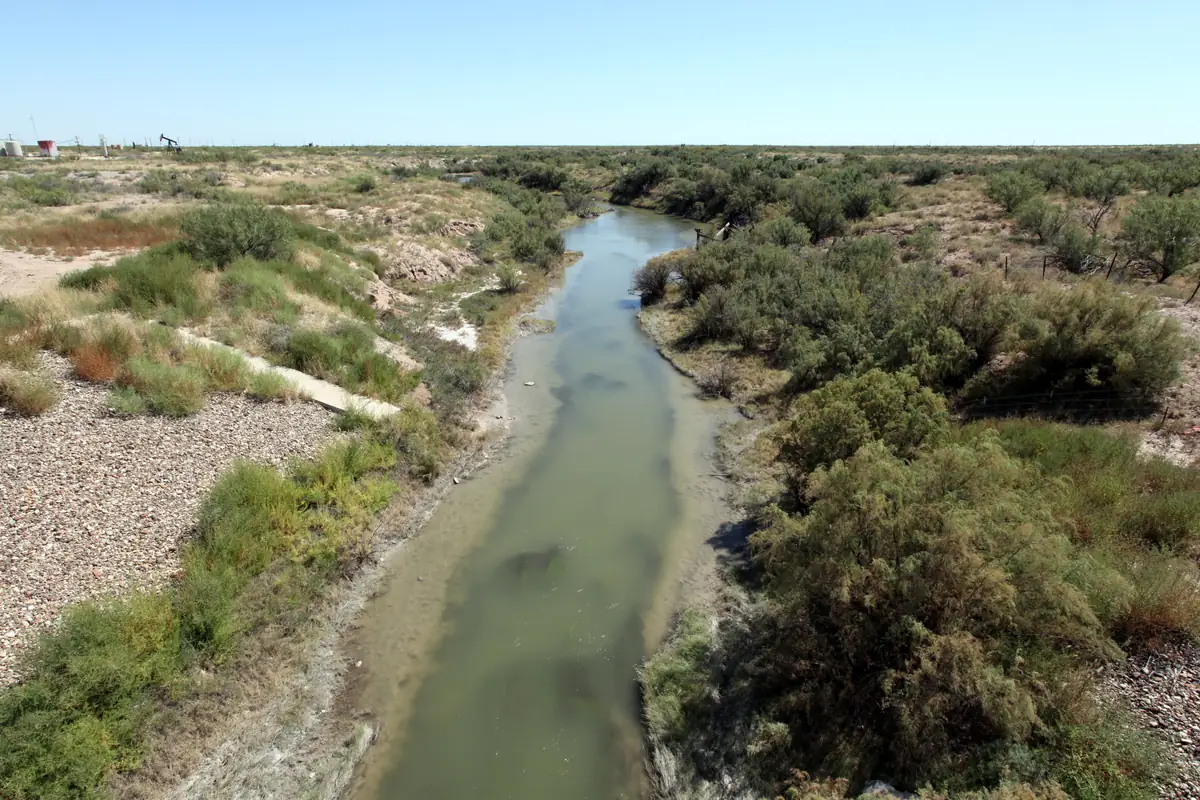
Photo: Pecos River south of Grandfalls, Texas, by Leaflet, CC BY-SA 3.0, via Wikimedia Commons

If a tank battery is covered by EPA's Spill Prevention, Control, and Countermeasure (SPCC) rule, every tank battery, separation and treating installation needs secondary containment that holds the entire capacity of the largest single container plus enough freeboard for precipitation. Drainage from areas without dikes has to be confined in a catchment basin or holding pond (40 CFR 112.9(c)(2)). Flow-through process vessels and produced water containers can use an inspection-based alternative instead.
Texas adds its own, narrower rule: Railroad Commission (RRC) Rule 21(j) requires firewalls around permanent oil tanks in certain locations, such as near highways, homes, schools and churches. This is a plain-language summary, not legal advice. Your facility's certified SPCC plan and the RRC district office have the final word.
Does SPCC apply to the battery?
According to EPA's guidance for the upstream sector, SPCC applies to a facility that:
- stores, uses or handles oil, which includes crude oil and fuels such as diesel;
- has more than 1,320 U.S. gallons of total aboveground storage, counting only containers of 55 gallons or more; and
- could reasonably be expected to discharge oil to navigable waters or adjoining shorelines.
The capacity line is low. At 42 gallons to the barrel, 1,320 gallons is about 31 barrels, so a single 100-barrel tank (4,200 gallons) is already well over it.
The third test is the one people argue about in dry country. EPA says to judge it by the facility's geography and location: nearby lakes, rivers, streams and creeks, and whether ditches, gullies or other drainage could carry a spill to them, along with soil, terrain and runoff. You must leave out manmade features such as dikes and assume they are not there. A battery that drains toward a draw feeding the Pecos River is a very different case from one on flat ground miles from any drainage. That call belongs in the written plan, not in someone's memory.
What 112.9 requires at a tank battery
- Compatible containers for the oil and storage conditions (112.9(c)(1)).
- Sized secondary containment for the largest single container plus precipitation freeboard, and catchment for undiked areas (112.9(c)(2)).
- Regular visual inspection of each container for deterioration and maintenance needs, including foundations and supports (112.9(c)(3)).
- At least one overfill safeguard (112.9(c)(4)): enough tank capacity that a delayed pumper or gauger does not mean an overflow, overflow equalizing lines between tanks, vacuum protection against collapse during a pipeline run, or high-level sensors that alarm to a production control computer.
- Sealed dike drains (112.9(b)(1)). Drains on dikes stay closed and sealed except when draining uncontaminated rainwater. Inspect before draining, and remove any oil on the rainwater and return it to storage or dispose of it properly.
- Field drainage checks (112.9(b)(2)). Inspect road and drainage ditches, oil traps, sumps and skimmers on a schedule, and remove oil promptly.
Sizing the firewall
The rule sets the target, the largest single tank plus freeboard, but not a specific storm. The professional engineer who certifies the plan decides what freeboard is enough for the site. To check a wall in the field, you need three numbers:
- Largest tank volume. One barrel is about 5.615 cubic feet.
- Usable volume inside the wall: the inside floor area times the wall height, minus the space taken up below the wall top by the other tanks, pads and equipment inside it. Those take up room that fluid cannot use.
- Freeboard for rain, as set in the plan.
For comparison, the RRC's guidance for oil and gas reclamation plants recommends secondary containment of 120% of total storage, or accepts a firewall that holds 100% of the largest tank plus the county's 25-year, 24-hour rainfall (RRC). That applies to reclamation plants, not lease batteries, but it shows how one Texas program spells out freeboard.
Produced water tanks and flow-through vessels
SPCC gives two kinds of equipment an alternative to sized containment.
- Flow-through process vessels such as separators and heater-treaters (112.9(c)(5)): inspect or test them and their parts, such as dump valves, on a regular schedule, fix problems, and promptly clean up any oil.
- Produced water containers (112.9(c)(6)): run a regular procedure to separate the free oil that builds up on top of the water, described in the plan and certified by a professional engineer, keep records of it, and inspect the tank and its piping on a schedule.
Both alternatives end after a bad record. If those vessels discharge more than 1,000 gallons of oil in one event, or more than 42 gallons in each of two events within 12 months, the facility has six months to bring them into sized containment. A produced water tank whose skimming procedure is not followed or not recorded loses the alternative too.
Flowlines
Flowlines and gathering lines inside the facility that lack secondary containment need an oil spill contingency plan and a written commitment of people, equipment and materials to control and remove a discharge. Every facility also needs a written flowline maintenance program covering compatibility, scheduled inspection or testing, repairs and prompt cleanup (112.9(d)).
The plan itself
- A licensed professional engineer must review and certify the plan (112.3(d)), unless the facility qualifies to self-certify. EPA says facilities with 10,000 gallons or less of total oil storage can generally self-certify; the full test also looks at spill history (112.3(g)).
- A new onshore production facility must have its plan prepared and in place within six months after it starts operating (112.3(b)).
- The plan must be reviewed at least once every five years and amended within six months if better prevention technology is available (112.5(b)).
- The plan has to be kept at the facility if the site is normally attended at least four hours a day (EPA).
Texas: Rule 21 firewalls
RRC Statewide Rule 21 does not require dikes or firewalls everywhere. Under Rule 21(j), firewalls must be built and kept around all permanent oil tanks or tank batteries that are:
- within the city limits of any city, town or village;
- closer than 500 feet to a highway or inhabited dwelling;
- closer than 1,000 feet to a school or church; or
- located where the Commission deems them an objectionable hazard.
Rule 21 also bans storing crude oil in open pits or earthen storage, and requires fire-hazard rubbish and debris to be kept at least 150 feet from wells, tanks and pump stations (16 TAC 3.21). Rule 21(j) sets no capacity, so where SPCC applies, its sizing is the working standard.
Keeping firewalls working
A firewall only counts if it holds. In one RRC enforcement case, inspectors found a battery firewall half full of fluid and oil, eroding and in need of reconstruction, and it later overflowed onto the next property (RRC final order). Things to check on every visit:
- Low spots, washouts and erosion on the wall, especially after storms
- Animal burrows, cracks and gaps where pipe passes through the wall
- Torn or exposed liner
- Rainwater or oil standing inside the wall, which uses up capacity
- Drain valves closed and sealed
- Weeds and dead brush inside and against the wall, which hide damage and burn
When something does get out, the cleanup rules are in our guides to crude oil spill cleanup (Rule 91) and saltwater spill cleanup.
How we help
Simba Services builds and repairs firewalls and secondary containment around tanks as part of our roustabout work across Midland, Odessa and the Permian Basin. We also run vac trucks to pull fluid out of containment, and do environmental cleanup when a release gets past the wall. We do not write or certify SPCC plans; that is a professional engineer's job. Bring us the plan's containment numbers and we will build or fix the wall to them.
Firewall eroded, undersized or missing? Send the lease, photos and the plan's containment numbers.
Request firewall workFAQ
How big does a tank battery firewall need to be?
Under SPCC, secondary containment must hold the entire capacity of the largest single container plus enough freeboard for precipitation (40 CFR 112.9(c)(2)). The certified plan sets the freeboard for the site.
Does SPCC apply to produced water tanks?
Yes, at a facility covered by SPCC. Produced water containers can meet sized containment, or use an alternative: an engineer-certified oil skimming procedure with records, plus scheduled inspections and repairs.
Does Texas require firewalls around oil tanks?
RRC Rule 21(j) requires firewalls around permanent oil tanks within city limits, within 500 feet of a highway or inhabited dwelling, within 1,000 feet of a school or church, or where deemed an objectionable hazard.
Who can certify an SPCC plan?
A licensed professional engineer, unless the facility is a qualified facility. EPA says facilities with 10,000 gallons or less of oil storage can self-certify if they also meet the rule's spill-history limits.
How often does an SPCC plan have to be reviewed?
At least once every five years under 40 CFR 112.5(b), with amendments within six months when more effective prevention technology is available. Changes at the facility can require amendments sooner.
Can rainwater be drained out of a tank battery dike?
Only uncontaminated rainwater. Under 112.9(b)(1), dike drains stay closed and sealed otherwise. Inspect first, and remove any oil on the water before draining.